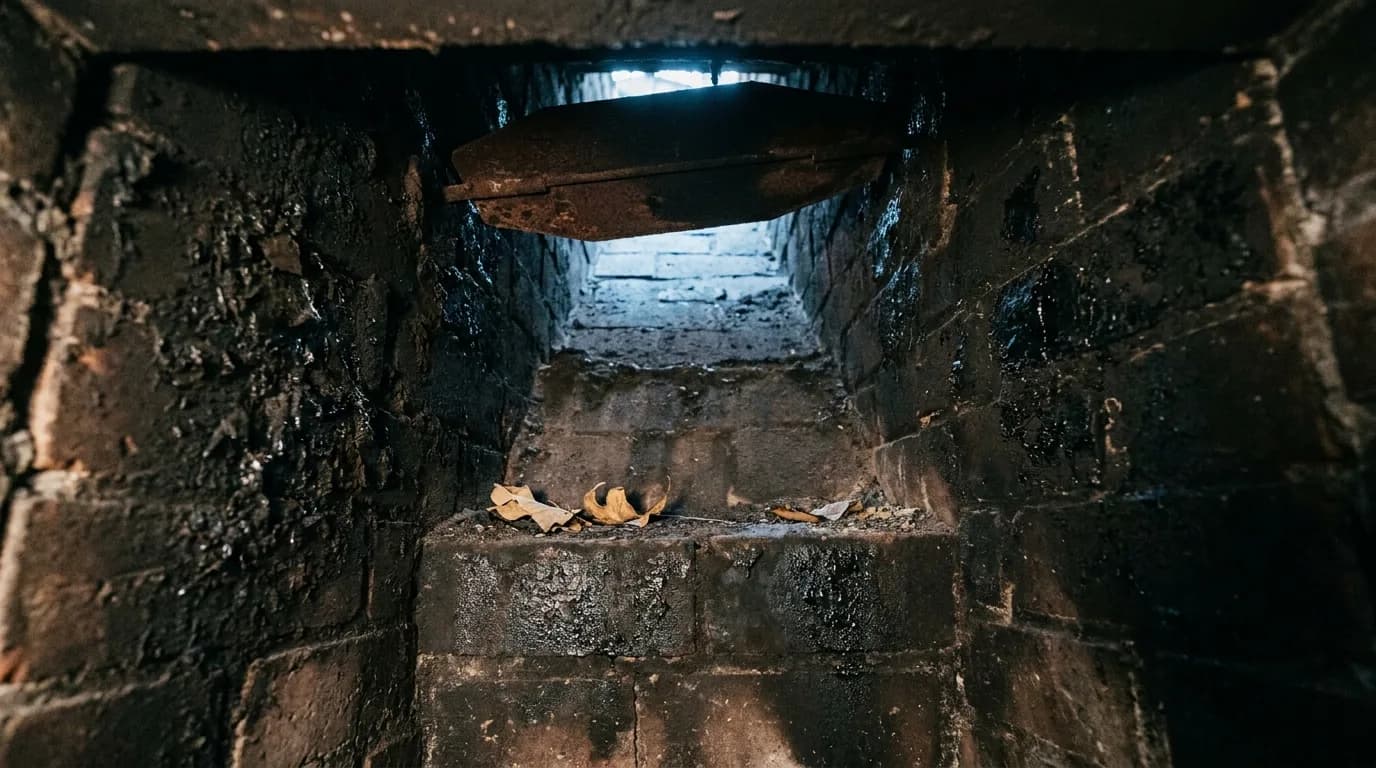
The first fire of the season is the one that causes problems. Creosote, nesting, a damper nobody has moved since spring — and the smoke damage that follows a flue that will not draw.
In Southern California a fireplace is a seasonal object. It runs on a handful of cool evenings between November and February and then sits untouched for eight or nine months. That gap is precisely the problem: nothing about a chimney improves while it is idle, and the first fire of the season is where the accumulated consequences show up.
Two outcomes send us to a house. One is a chimney fire. The far more common one is a flue that would not draw properly and put smoke into the living room — which does not make the news and still costs thousands to remediate.
Creosote is the main hazard, and it builds faster than people expect
Creosote is the residue of incomplete combustion — unburned wood gases that condense on the relatively cool inner surface of the flue. It accumulates in stages, starting as a light soot, progressing to a flaky, tarry layer, and eventually hardening into a glazed coating that is difficult to remove and highly combustible.
What accelerates it is exactly what most casual fireplace users do: burning unseasoned or damp wood, running the fire slow and smoldering rather than hot, and closing the damper down to make a fire last. Every one of those cools the flue and lowers combustion efficiency, which is the recipe for deposition.
A chimney fire is creosote igniting inside the flue. Sometimes it is dramatic and obvious. Often it is a slow, quiet burn that nobody notices from the room, and it damages the flue liner — leaving cracks that let heat and combustion gases reach the framing on subsequent fires. That is how a fire two weeks later starts in a wall.
What else collects in an unused chimney
- Bird and rodent nesting. A chimney that has been quiet since spring is attractive real estate, and a nest is both a blockage and fuel. If you do not have a chimney cap, assume something has been up there.
- Leaf and debris accumulation on the smoke shelf, particularly under live oaks and after Santa Ana winds.
- A damper seized with rust or corrosion. The spring and summer humidity cycle does this, and it is the most common single finding.
- Spalling or cracked masonry and deteriorated mortar joints, which heat and water cycling worsen year over year.
- A cracked or missing chimney crown, which lets water into the structure and is the usual cause of the damage below it.
The smoke event is the likelier outcome
A partially blocked flue, a closed or stuck damper, or a cold flue that has not established draft will push smoke back into the room. People notice within a minute or two and open the doors, and by then it is already done.
Smoke moves with air, which means it goes everywhere the air goes. Particulate settles on walls and ceilings and into soft contents — upholstery, curtains, carpet, bedding, clothing in open closets. More to the point, the odor compounds are volatile and they re-release into the air for weeks, which is why a room that smells acceptable the next morning smells strongly again on the first warm afternoon.
Running the HVAC system to clear it, which is nearly everyone's reflex, distributes residue into the ductwork and from there into rooms that had no smoke in them at all. We go through the right sequence in how to get smoke smell out of a house. The short version is that ventilation with outside air helps and recirculating the air through the house does not.
Before you light the first fire
- Open the damper and look up with a flashlight. You are checking that it opens fully, that you can see daylight at the top, and that there is no nest, no debris, and no heavy flaky or glazed buildup on the flue walls.
- Have the chimney inspected and swept if it has not been done in the last year of use, or at all. A Level 1 inspection is inexpensive relative to what it rules out.
- Confirm the chimney has a cap with a screen. It keeps out nesting, rain, and embers, and in Santa Ana season it is also wildfire protection.
- Burn only seasoned hardwood. Not construction scrap, not treated or painted lumber, not cardboard, not a Christmas tree. Treated wood puts chemicals into the house and into the flue.
- Build a hot fire rather than a smoldering one, and leave the damper fully open while it burns. Efficiency and safety point the same direction here.
- Keep the five feet in front of the hearth clear, use a screen or glass doors, and never leave a fire unattended.
- Test the smoke alarms and the carbon monoxide alarms on the same day. A blocked flue produces carbon monoxide, and that is the hazard that does not announce itself.
Ash disposal deserves its own line because it causes house fires every year. Embers stay viable in an ash bed for days. Ashes go in a metal container with a lid, set on concrete away from the structure, and they stay there for several days before anything else happens to them. Not a paper bag, not a plastic bin, not the garage.
Gas fireplaces are not exempt
A gas log set produces no creosote, which leads people to skip inspection entirely. The flue still needs to be clear — a nest blocks a gas appliance exactly as well as it blocks a wood fire, and the combustion products include carbon monoxide. Gas fireplaces also accumulate dust and spider webbing in the burner assembly over a long idle season, which is the usual reason the first lighting produces an odor and uneven flame. Have it serviced and the venting verified before the season.
Frequently asked questions
- How often should a chimney be swept in Southern California?
- An annual inspection is the standard recommendation regardless of use, with sweeping as needed based on what the inspection finds. Light seasonal use does not eliminate the need — nesting, debris, and masonry deterioration happen whether or not you burn.
- How do I know if I have had a chimney fire?
- Common signs include puffy or honeycombed creosote, cracked or flaked flue tiles, warped damper components, discolored or distorted caps, creosote flakes on the roof or in the yard, and a roaring sound reported during a fire. If you suspect one, do not use the fireplace again until it has been inspected.
- Does homeowners insurance cover a chimney fire?
- Fire is a covered peril on essentially every homeowners policy and FAIR Plan dwelling fire policy, so the resulting damage is usually covered. Where carriers push back is on the chimney component itself if the cause is traced to a lack of maintenance. Keep sweep and inspection receipts.
- Why does my house smell like smoke the day after a fire?
- Odor compounds absorbed into porous materials release slowly over time, and they release faster as temperature and humidity rise. That is why the smell seems to come back on a warm afternoon. Surface cleaning and air fresheners mask it; removing it requires treating the materials that absorbed it.
If the first fire went badly
Gallagher Restoration Co. handles fire damage restoration and smoke remediation across Riverside, San Bernardino, Orange, and San Diego counties — family-owned, IICRC-trained, CSLB #1061640, 24/7 dispatch with a 60-minute on-site target. Call (951) 541-0034 or request an assessment. If you want the groundwork, the basics of fire damage is a good starting point.