Six dry months do real damage to a roof, and the first storm is the inspection. What fails first, why the stain never appears above the leak, and what to check before the clouds arrive.
Southern California roofs do not weather the way roofs elsewhere do. They do not freeze, thaw, or carry snow load. What they do is sit in intense UV and heat for six to eight months without a drop of water, and then get tested all at once.
That is the pattern behind a spike in calls we see every year: the first real storm arrives, and a roof that was fine in April is suddenly not. Nothing changed during the storm. The summer did the damage, and the rain simply found it.
What a dry summer actually does
- Sealants and mastic around vents, flashing, and penetrations dry, shrink, and crack. This is the single most common entry point and it is almost never the shingles or tile themselves.
- Asphalt shingles lose granules and go brittle. Heat cycling curls the edges and lifts the seal strip.
- Tile roofs shift. The tile is not the waterproofing layer — the underlayment beneath it is — and underlayment is what degrades in heat. A roof can look perfect from the street with failed felt underneath.
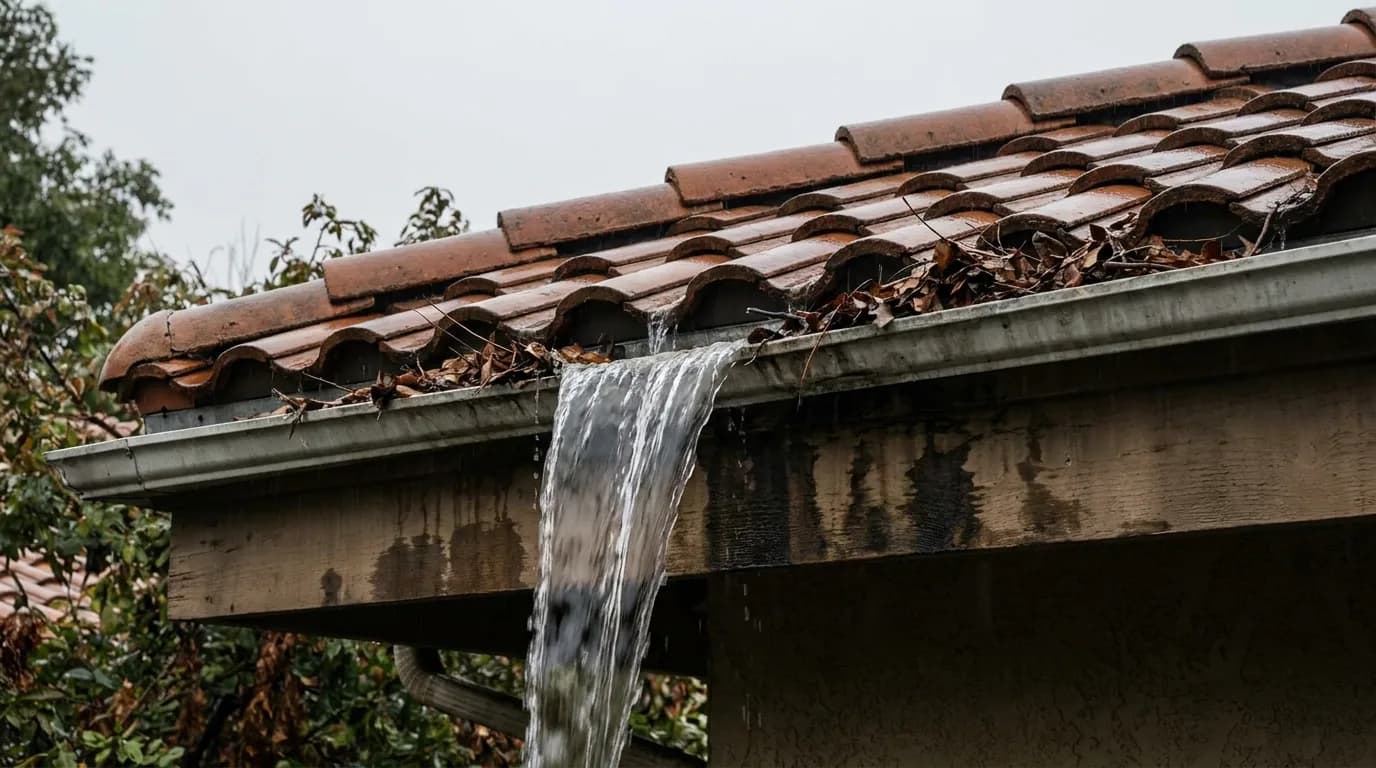
- Debris accumulates. Leaves, jacaranda litter, palm fronds, and dust pack into valleys and gutters where there has been no water to wash them through.
- Rodents and birds find the eaves during the dry months, and the openings they make do not close on their own.
The gutters deserve particular mention because they are the easiest thing on the list to fix and the most consistently ignored. A gutter packed with eight months of dry debris does not overflow politely over the front lip. It backs up under the roof edge, soaks the fascia, and runs behind the drip edge into the soffit — which is how a gutter problem becomes an interior problem.
The first storm is rarely the one that reveals it
A short, light first rain wets everything and stops. The second or third storm — or the first one that runs for several hours — is when the ceiling stain appears, because the materials above the ceiling have to saturate before anything shows below.
This matters for a practical reason. By the time you see the stain, water has been in the assembly for days or weeks across multiple storms. Insulation is wet, framing is wet, and the conditions for mold growth have been in place long enough to matter. A ceiling stain is a late indicator, not an early one.
The stain is almost never under the leak
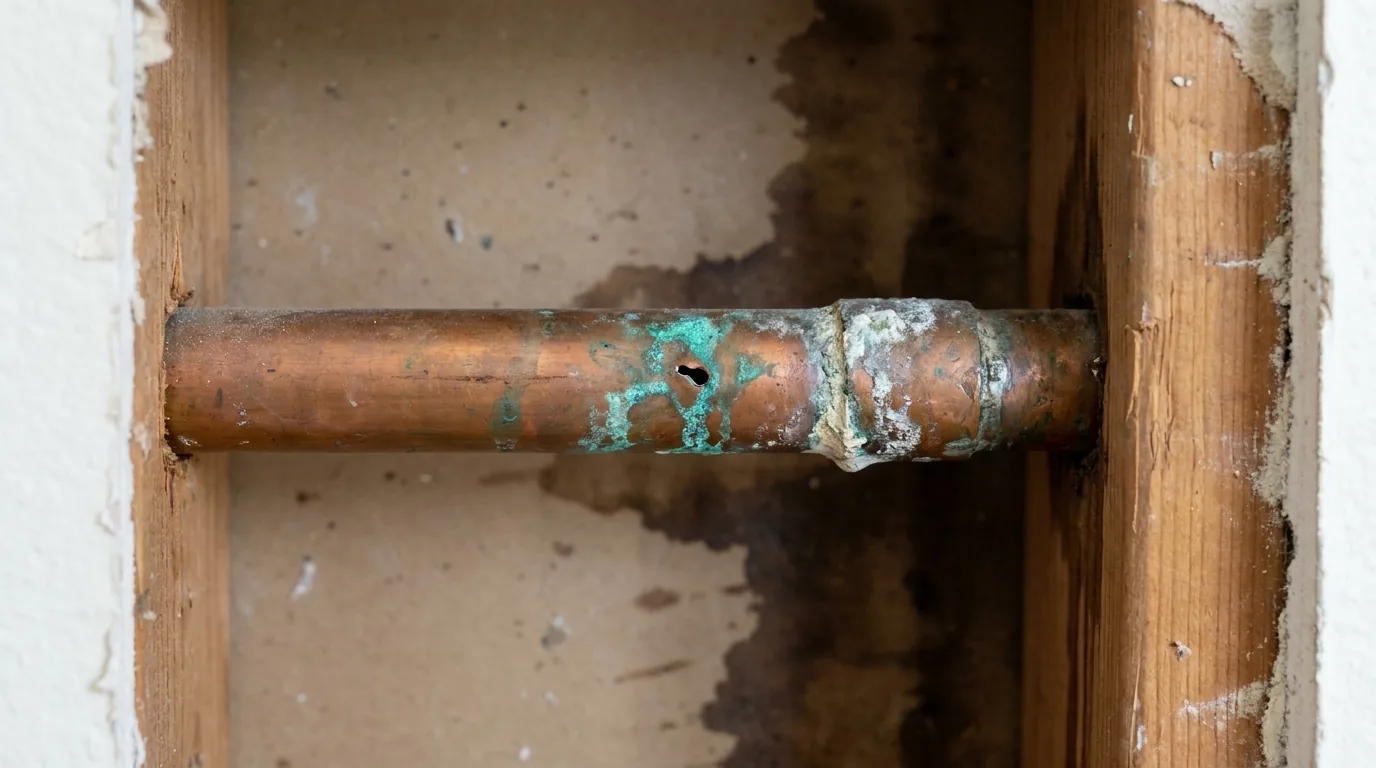
Water enters at the roof, lands on the top of the ceiling or on a framing member, and then travels. It runs along rafters, follows ductwork, and moves across the top plate of a wall until it finds a low point or a seam — a light fixture, a ceiling joint, a bath fan housing.
A stain over the hallway can easily be a failed vent boot fifteen feet away. This is why chasing the stain usually produces two repairs and one leak that is still there. Finding the actual entry point takes moisture mapping from above, and sometimes a controlled water test on the roof. Our page on roof water damage explains the sequence we use.
What to check before the rain, in order of return on effort
- Clear gutters and downspouts completely, and confirm water actually exits at the bottom. Run a hose.
- Confirm downspouts discharge away from the foundation. A downspout dumping at a slab corner is a different problem that shows up as a wet baseboard with a perfectly good roof.
- Look up at the roofline from the ground with binoculars or your phone camera zoomed in. You are looking for lifted or missing shingles, cracked or slipped tile, and daylight anywhere it should not be.
- Inspect the attic on a bright day with the lights off. Daylight through the roof deck, dark staining on the sheathing, compressed or discolored insulation, and rodent entry all show up clearly.
- Check around every penetration — plumbing vents, bath fans, the chimney, skylights, and any solar mounting. The seal is what fails, not the pipe.
- Walk the perimeter and look at the fascia for dark streaking or soft wood. That is last season's gutter overflow telling you about this season.
Do all of this from the ground or from the attic. A tile roof in particular is easy to damage by walking on it, and the repair bill for cracked tile frequently exceeds whatever the inspection was going to save.
When the stain does appear
- Put something under it and photograph it with a timestamp. Repeat after each storm. A stain that grows between storms is an active leak; a stain that does not is historical.
- If the ceiling is sagging or bulging, stay out from under it. Saturated drywall holds a surprising amount of weight and then releases it all at once.
- Do not paint over it. Stain-blocking primer hides the only indicator you have of whether the leak is still active.
- Get the roof covered before you worry about the interior. Drying a ceiling that is still being rained into accomplishes nothing.
- Then get the assembly dried properly — not just the visible drywall. Wet insulation does not dry on its own inside a closed ceiling.
Why the ceiling usually needs to come out
Homeowners reasonably ask whether a stained ceiling can be dried in place and repainted. Sometimes. The deciding factor is the insulation above it. Blown-in or batt insulation that has been wet loses its loft, holds moisture against the drywall, and cannot be dried effectively through an intact ceiling. If the saturated area is small and the insulation above it is dry, in-place drying is realistic. If the insulation is wet, opening the ceiling is faster, cheaper, and the only way to verify the cavity is actually dry rather than assumed dry.
Frequently asked questions
- Does homeowners insurance cover roof leaks?
- Generally it covers sudden damage from a covered peril — wind lifting shingles, a branch puncturing the deck — and the resulting interior damage. It generally does not cover a roof that failed from age and deferred maintenance, and many carriers will decline the interior damage too if the cause is long-term wear. Documentation of the storm and the condition before it is what separates those two readings.
- How quickly does mold grow after a roof leak?
- Given a wet organic surface and ordinary indoor temperatures, growth can begin within 24 to 48 hours. In a ceiling cavity with wet insulation and little airflow, conditions stay favorable for a long time, which is why the length of time a leak went unnoticed matters more than the volume of water.
- Can I dry a wet ceiling with a fan and a dehumidifier?
- You can dry the surface, which is not the same thing. The question is what is above it. Without a moisture meter you are guessing, and a ceiling that reads dry on the painted face while holding wet insulation above will come back as staining, sagging, or odor weeks later.
- Should I call a roofer or a restoration company first?
- Both, in that order of urgency — the roof has to stop the water, and the restoration has to dry what already got in. If the interior damage is significant, calling a restoration company first is reasonable because documenting the loss properly starts before repairs begin.
Before the season starts
Gallagher Restoration Co. has handled water damage restoration across Riverside, San Bernardino, Orange, and San Diego counties for more than 15 years. Family-owned, IICRC-trained, CSLB #1061640, 24/7 dispatch with a 60-minute on-site target. If you have a ceiling stain you have been watching, call (951) 541-0034 or request an assessment. Our winter preparation guide covers the rest of the house.