Water dry-out services in Southern California industrial drying, moisture mapping, mold prevention
Visible water is gone, but the structure is still wet. Gallagher Restoration Co. provides professional water dry-out services across four Southern California counties—using industrial air movers, commercial dehumidifiers, and thermal imaging to confirm dryness all the way through wall cavities and subfloor.
Typical arrival across 4-county SoCal
Answered by a real person
Typical structural dry-out duration
What is water dry-out?
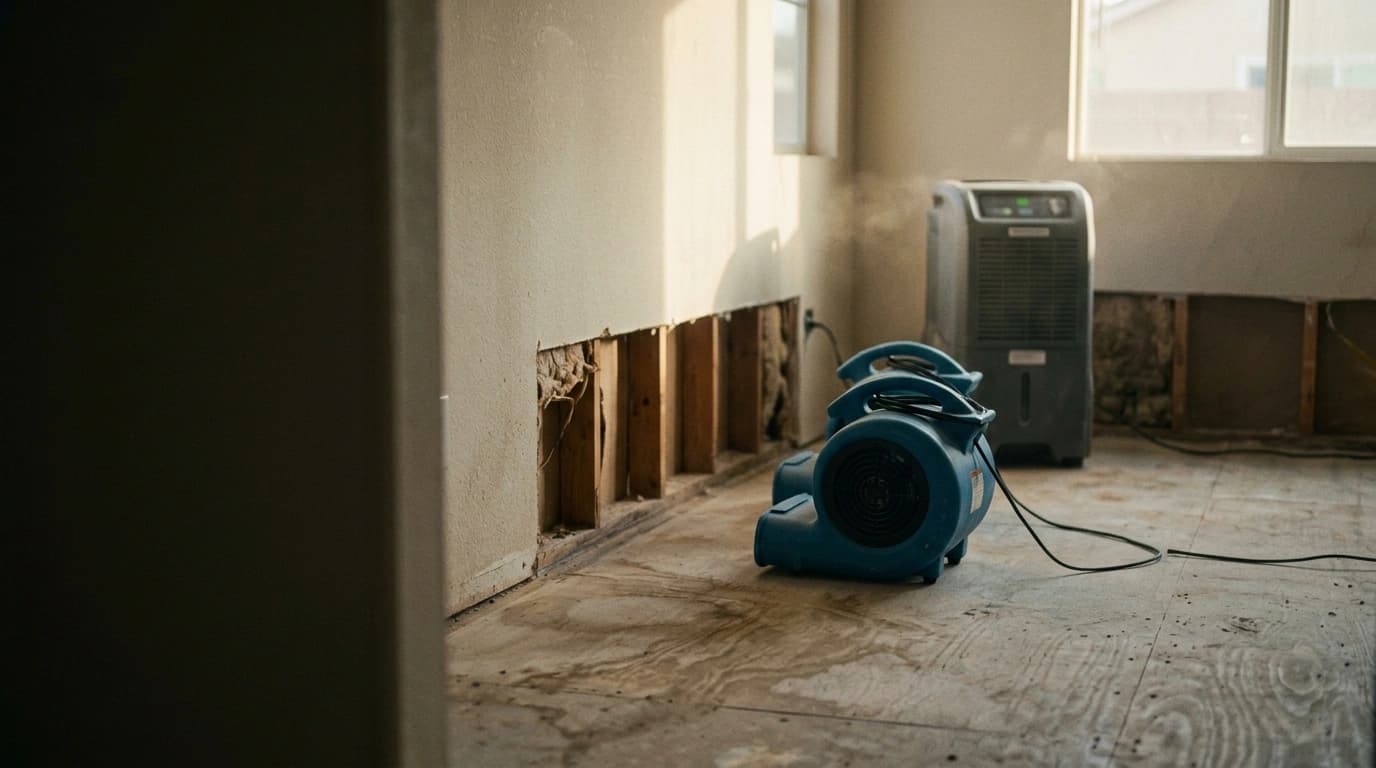
Water dry-out is the structural drying phase of water damage restoration—the engineered process of removing moisture from building materials after standing water has been extracted. It is not the same as letting a space air-dry. Professional dry-out uses calibrated combinations of high-velocity air movers, commercial-grade dehumidifiers, and sometimes desiccant systems to force moisture out of wall cavities, subfloor, framing, and insulation at a controlled rate. Technicians map moisture levels daily using thermal imaging cameras and calibrated meters, adjusting equipment placement as drying progresses. The process typically runs three to five days for residential jobs, though heavily saturated structures or those with dense materials—concrete slab, thick hardwood, spray foam insulation—can take longer. Without professional dry-out, moisture trapped inside materials creates ideal conditions for mold within 24 to 48 hours.
How Gallagher handles water dry-out
Baseline moisture mapping
Before equipment is placed, technicians establish a moisture baseline across all affected materials using thermal imaging and calibrated pin and pinless meters. This map identifies exactly which structural elements are wet, at what depth, and to what degree—information that determines equipment placement and expected drying duration.
Industrial drying equipment placement
High-velocity air movers are positioned to create a circular airflow pattern across wet surfaces, accelerating evaporation. Commercial dehumidifiers capture moisture from the air before it can reabsorb into surrounding materials. Equipment density and placement are calculated based on the moisture map, not guesswork.
Daily monitoring and adjustment
Technicians return daily to take moisture readings at every documented point. Equipment is repositioned or added as drying progresses and wet spots shift. Daily readings are logged in writing—this documentation becomes part of the insurance claim file.
Dry standard confirmation and clearance
Drying is not complete when materials feel dry to the touch—it is complete when moisture meter readings reach the manufacturer’s dry standard for each material type. Gallagher provides written clearance documentation before the structure is closed, which insurance carriers require before reconstruction begins.
Signs you need professional water dry-out now
A plumber fixed the leak but the walls and floor still feel damp
Fixing the source stops new water from entering but does not remove what is already inside the structure. A plumber repair and a dry-out are two separate jobs that must both be completed.
You ran fans for 48+ hours and still smell moisture
Household fans create airflow at the surface but cannot reach moisture trapped inside wall cavities, subfloor, or insulation. A persistent damp smell after 48 hours of fan use typically means moisture is still present at depth.
Drywall or wood flooring feels cool to the touch relative to surrounding areas
Cooler surface temperature in a localized area is a classic thermal imaging signal—evaporating moisture cools the surface. This is often invisible to the eye and only detectable with a thermal camera or moisture meter.
Moisture readings were taken during clean-up but never confirmed at dry standard
Initial moisture mapping at the start of a job establishes a baseline, not a clearance. Without daily monitoring and a final dry-standard reading, there is no documentation that drying was completed—a problem for both mold risk and insurance claims.
A previous dry-out was stopped early and mold has since appeared
If equipment was removed before materials reached dry standard—either to save cost or because the job was declared complete prematurely—mold colonization in wall cavities is the common result. The structure needs both remediation and a completed dry-out.
Why homeowners call Gallagher for water dry-out
The most common dry-out failure Gallagher Restoration Co. sees in Southern California is equipment pulled too early—either because a homeowner wanted the noise and disruption to end, or because a crew declared victory based on surface feel rather than meter readings. Moisture left in wall framing, subfloor, or behind tile sets up a mold event that typically surfaces 30 to 90 days later, often after the original claim has closed. The company’s technicians are IICRC-trained in psychrometrics—the science of drying—and document daily moisture readings in writing so the insurance carrier and homeowner both have a verifiable record of the drying timeline. Gallagher has run dry-out projects across Riverside, San Bernardino, Orange, and San Diego counties for more than 15 years, and the same crew that manages drying transitions directly into clean-up and reconstruction when the structure is confirmed clear. Call (951) 541-0034—a real person answers.
Water dry-out pricing—what to expect
Every job starts with a free on-site assessment. Water dry-out in Southern California typically runs $800–$5,000 depending on the square footage of affected area and the number of days equipment must run. The low end covers a limited single-room event with fast initial response and clean water—dry standard reached in three days with a moderate equipment set. The upper end reflects larger multi-room events, dense building materials like concrete slab or engineered wood that hold moisture longer, or events where delayed response extended saturation time and required extended equipment runs. Equipment rental, daily monitoring visits, and all moisture documentation are included. Gallagher Restoration Co. logs readings daily and provides written dry-standard clearance—the document your adjuster needs before releasing the reconstruction payment.
Also handled by the same crew
Water dry-out services in Southern California — questions we hear.
Why can't I just use fans and open windows to dry out water damage?
Household fans and open windows address surface moisture only. Water from a damage event penetrates into wall cavities, subfloor, insulation, and structural framing where ambient airflow cannot reach. Industrial air movers generate velocity that penetrates deeper materials, and dehumidifiers remove the evaporated moisture from the air before it reabsorbs. In Southern California, warm outdoor air during summer months can also introduce humidity that slows or reverses drying.
How long does structural water dry-out take?
Most residential water dry-out jobs in Southern California reach dry standard in three to five days. Concrete slab, thick hardwood, or spray-foam insulation can extend the timeline to seven to ten days. The only reliable way to know the job is done is a final calibrated moisture reading at dry standard for each material type—not a fixed number of days.
Does insurance cover water dry-out costs?
Yes, for sudden and accidental water events. The dry-out phase is typically the largest line item in a mitigation claim, and carriers require daily moisture logs and a final dry-standard clearance document to process the payment. Gallagher Restoration Co. provides all of that documentation automatically as part of every dry-out job.
What happens if the dry-out is not done correctly?
Mold colonization is the primary risk. In Southern California’s warm interior climate, mold can begin growing within 24 to 48 hours in residual moisture. An incomplete dry-out—where equipment was removed before materials reached dry standard—typically results in a mold discovery 30 to 90 days later, a new remediation claim, and potential coverage disputes if the carrier documents that drying was not completed properly.
How can I prevent mold growth after water damage?
Ensure thorough drying of affected areas within 24–48 hours—the window before mold typically begins colonizing. Use industrial dehumidifiers and air movers rather than household fans, apply antimicrobial agents to affected structural surfaces, and address any material that stays wet after 48 hours. Confirming dryness with a calibrated moisture meter is the only reliable way to know the risk is closed.
Trusted Across Southern California
“I can’t say enough good things about Gallagher Restoration. I am extremely happy and satisfied with the work and effort from their entire team. From day one, everyone was professional, helpful, and knowledgeable. Anytime I had questions, they either had the answers right away or took the initiative to find them and point me in the right direction. Their communication was consistent and timely—even after 12 months into this process, they continued to respond quickly and support me when I needed…”
 Saul Huerta
“I came home to leak from the upstairs bathroom. Called Gallagher Restoration after hours. Nick was so nice and confirmed they would be out early the next morning. Nick and Daniel were respectful of our home, made sure to protect everything. The communication was outstanding throughout the entire process. I would highly recommend Gallagher Restoration Jennifer, Nick, and Daniel.”
 DeAnn Smith
“I really appreciate the work done by David Schumm of Gallagher Restoration during a recent AC condensation leak in my attic. David was incredibly professional, communicative, and easy to work with through the whole process. He made a stressful situation so much easier to manage, taking the time to explain everything clearly and ensuring our home was taken care of properly. I highly recommend David and the team at Gallagher Restoration if you ever need reliable, honest service. Thank you.”
 AE Galvan
“I have really bad water damage to my flooring in my bathroom. Gallagher Restoration was recommended by my property management company and I would also recommend Gallagher Restoration as well because they truly delivered. The first person on the team that came out to my home for water damage to my flooring in my bathroom was Nick, Nick was friendly and very polite. The day that Nick showed up to my house he was on time like he said he would be and very respectful. Nick communicated with me…”
 Lateraa Frierson
“Super friendly and professional service. We had nick, Frankie and David out. They were fast , professional, thorough and friendly. 10 out of 10 definitely recommend”
 Margaret Cruz
Property Damage? Gallagher Restoration Is Ready to Help.
When water, fire, mold, or another emergency damages your property, getting professional help quickly matters. Contact Gallagher Restoration for fast, experienced restoration services throughout Southern California.