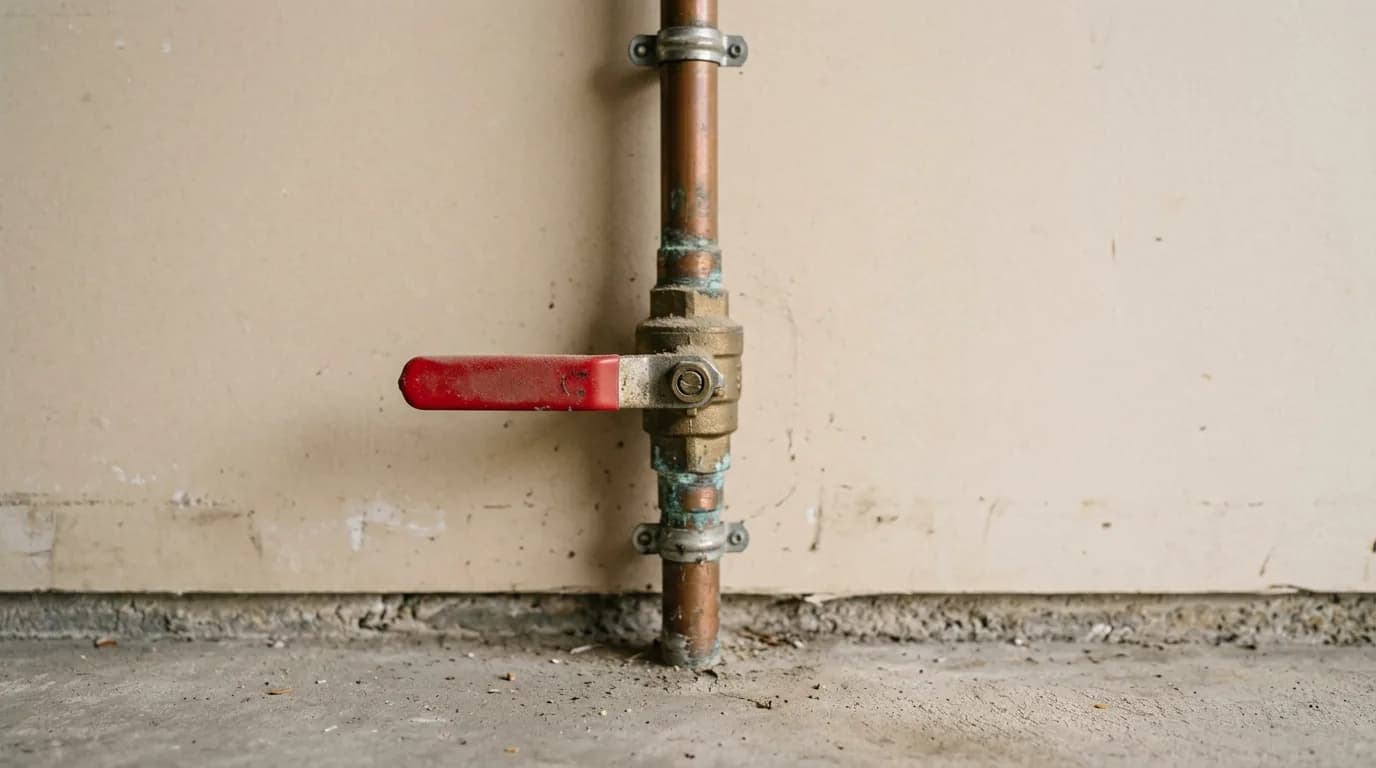
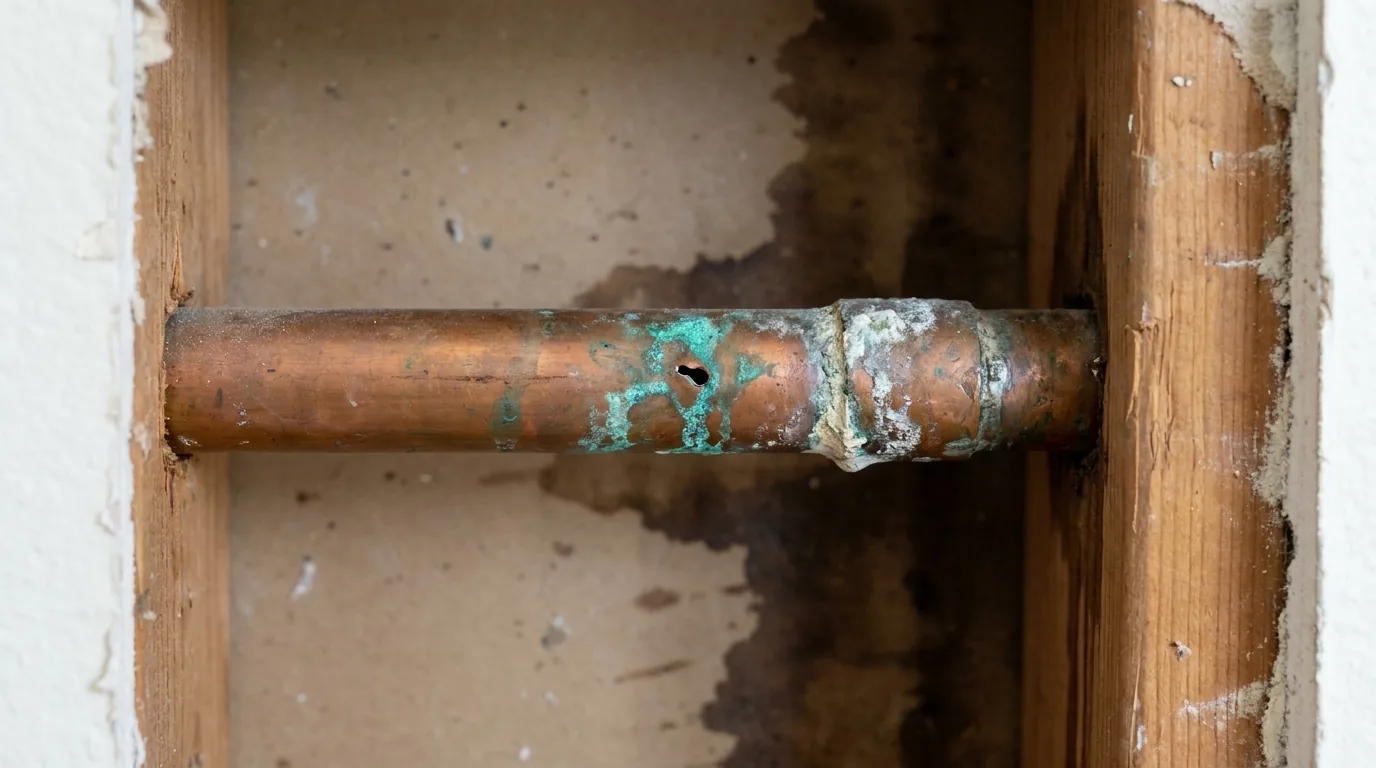
A pinhole leak is a pressurized spray the size of a needle, usually inside a wall. Why Inland Empire water is hard on copper, what the first signs look like, and why one pinhole predicts the next.
A pinhole leak sounds minor and is not. It is a perforation in the wall of a copper supply line, typically smaller than a pencil tip, with household water pressure behind it. In open air it looks like a fine spray. Inside a wall cavity, that spray runs against framing and drywall continuously, for as long as it takes someone to notice.
Across much of Riverside and San Bernardino counties, this is one of the most common causes of hidden water damage we respond to in homes built from the 1960s through the 1990s. It is also the one homeowners are least prepared for, because nothing about it announces itself.
Why copper fails here
Copper pipe is durable and the great majority of it lasts decades. What shortens its life is the chemistry of what runs through it, and Inland Empire water is hard — high in dissolved calcium and magnesium — with mineral content that varies by source and season.
Several things follow from that. Mineral scale deposits on the inner wall, which narrows the bore and raises velocity through the restriction. Higher velocity and turbulence erode the protective oxide layer that normally forms on the inside of copper pipe. Where that layer is disrupted, localized pitting begins, and pitting that progresses all the way through the wall is a pinhole.
Several ordinary conditions make it worse, and they are common in tract housing:
- High static water pressure. Anything much above 80 psi stresses the entire system and accelerates erosion. Many homes in the region run high and nobody has ever checked.
- Undersized or aggressively routed pipe, which raises velocity — long runs with many tight elbows are the usual culprits.
- Hot water lines, which fail earlier than cold ones. Heat accelerates both scale formation and corrosion.
- Thin-wall type M copper, used widely in residential construction, which simply has less material to lose than type L.
- Flux residue left at joints during original installation, which stays mildly corrosive for the life of the pipe.
What you notice first, and what it usually means
- Green or blue-green staining on exposed copper, at fittings, or in a sink or tub. Copper in the water is copper leaving the pipe.
- A small bubbling or blistered spot in paint on a wall, often near a bathroom or kitchen. This is frequently the first visible sign and it is already a wall-cavity leak.
- A warm or damp spot on a wall, or a baseboard that has darkened at the bottom edge.
- A faint hissing or trickling sound with all fixtures off.
- A water bill that has moved without a change in usage.
- Repeated minor plumbing repairs in the same house over a couple of years. This is the pattern that matters most, and it is addressed below.
Signs one through three mean water has already been in the assembly. Unlike an appliance leak, there is no catch pan and no floor to pool on — the water goes directly into insulation, framing, and the back of the drywall, where it stays warm, dark, and wet. Mold growth under those conditions can begin within a couple of days, which is why pinhole leaks disproportionately turn into remediation jobs rather than drying jobs. Our post on signs of mold behind walls covers what that looks like from the room side.
One pinhole is information about the rest of the system
This is the part worth internalizing. A pinhole is not usually a defect at one unlucky spot. It is the first place that a system-wide condition — water chemistry, pressure, velocity, pipe type, age — happened to finish first.
The rest of the copper in the house has been exposed to the same conditions for the same number of years. A homeowner who patches one leak and considers the matter closed frequently has another within a year or two, often in a worse location. Two or three pinholes in a short span is the system telling you something, and at that point the useful conversation is about repiping rather than about the next repair.
| Situation | Reasonable Response |
|---|---|
| First pinhole, house under 30 years old, pressure normal | Spot repair, then test pressure and inspect accessible pipe |
| First pinhole, house 40+ years old on original copper | Spot repair now, plan and budget for repiping |
| Second or third pinhole within two years | Repipe. Continuing to patch is more expensive over time |
| Pinhole in a slab or inaccessible run | Reroute rather than open the slab, where the layout allows |
| Any pinhole with visible staining or odor nearby | Moisture assessment of the cavity before the wall is closed |
What reduces the risk
- Measure your static water pressure. A gauge that threads onto a hose bibb costs very little. If you are above 80 psi, a pressure-reducing valve addresses the single biggest controllable factor — and protects the water heater, the washing machine, and every supply hose in the house at the same time.
- Address water hardness. A softener or conditioner reduces scale deposition, which reduces the velocity and turbulence that drive pitting.
- Have the water heater flushed annually. Sediment and scale there are the same chemistry showing up somewhere you can actually see it.
- Pay attention to the first blistered paint spot rather than painting over it.
- Install leak detection on the main with automatic shutoff. For a leak that starts inside a wall at two in the morning, this is the only measure that limits the loss.
When one opens up
A pinhole can become a full rupture without warning — the surrounding material is already thinned. If that happens, close the main, turn off the water heater, and get the water out before it migrates. Supply water starts clean and does not stay that way; the progression is covered in water damage categories explained, and the response in pipe burst flooding and remediation.
The part that gets skipped is the cavity. Once the plumber has made the repair, the wall still holds wet insulation and wet framing, and closing it up at that point guarantees a second call in a month. Drying has to be verified with meter readings inside the cavity, not assumed from a dry-looking surface.
Frequently asked questions
- How long does copper pipe last in hard water?
- Copper can last fifty years or more under favorable conditions, and considerably less under hard water with high pressure and thin-wall pipe. In the Inland Empire, failures starting in the twenty-five to forty year range are common, with hot water lines going first.
- Does homeowners insurance cover a pinhole leak?
- Policies commonly cover the resulting water damage when the discharge is sudden and accidental, while excluding the pipe repair itself and excluding damage from leaks that occurred gradually over an extended period. A pinhole that sprayed into a cavity for months is exactly the fact pattern carriers scrutinize, which is why acting on the first blistered paint matters financially as well as structurally.
- Should I repipe in copper or PEX?
- Both are used routinely in Southern California residential repipes. PEX is not subject to the pitting corrosion mechanism described here and is generally faster and less invasive to install; copper has a longer track record and some homeowners prefer it. That is a conversation for a licensed plumber who has seen your system, not a decision to make from an article.
- Can I hear a pinhole leak?
- Sometimes, in a quiet house late at night with an ear to the wall. Often not. The more reliable indicators are the water bill, the paint, and the staining. If you suspect one and cannot find it, shutting off every fixture and watching whether the water meter still moves is a straightforward test.
If you have found water in a wall
Gallagher Restoration Co. runs 24/7 dispatch across Riverside, San Bernardino, Orange, and San Diego counties with a 60-minute on-site target, handling water damage repair from assessment through rebuild. Family-owned for more than 15 years, IICRC-trained, CSLB #1061640, direct carrier billing and daily moisture documentation. Call (951) 541-0034 or request an assessment.