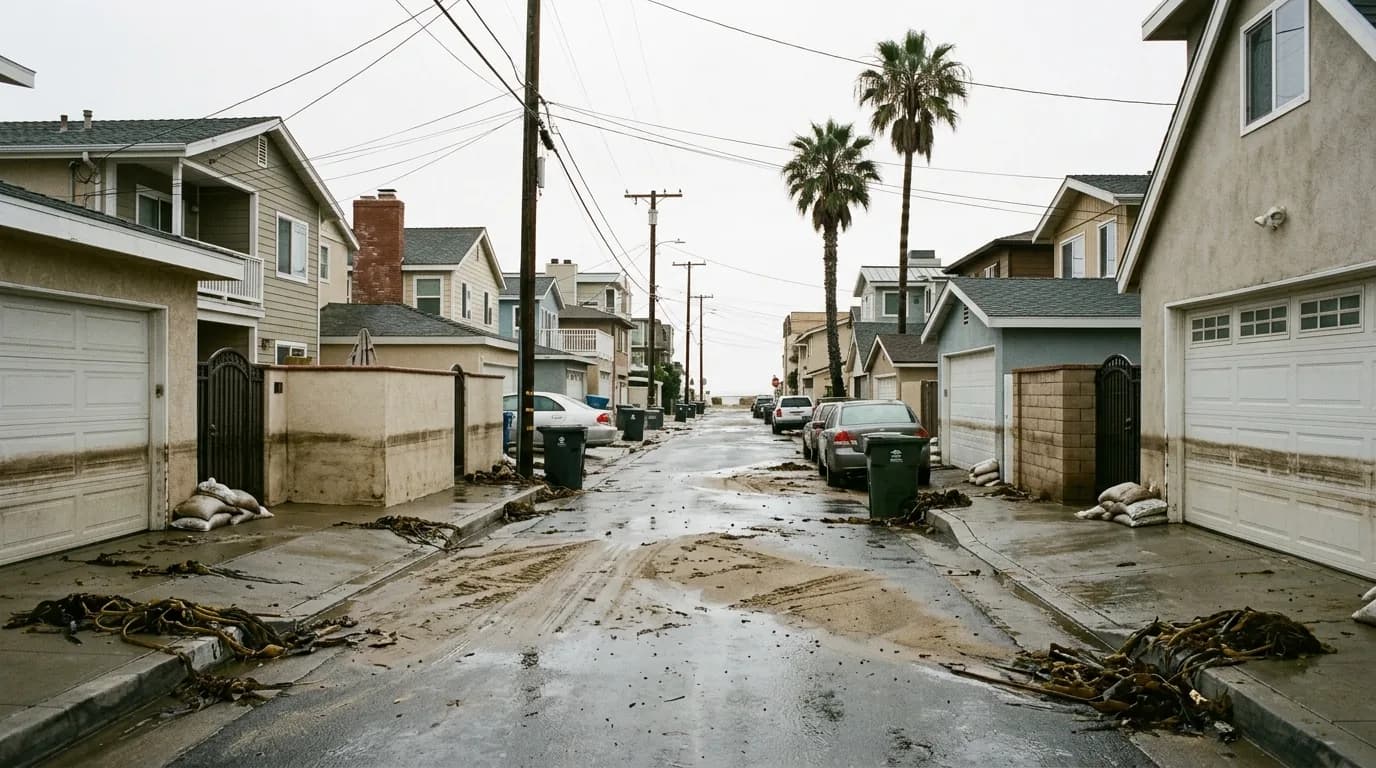
Seawater evaporates and the salt does not. That one fact changes the category, the scope, and the reason a wall that passed a moisture reading reads wet again a week later.
Coastal flooding is a different loss from a burst pipe, and the difference is not the volume of water. It is what is dissolved in it.
When surf and high tide push water over a berm and into residential streets — which happened along the Orange County coast this month — the water arriving in those homes is seawater that has crossed streets, yards, and storm drains on the way in. Treating it as a large clean-water loss is the most common and most expensive mistake made on these claims.
Storm surge is Category 3 water
Industry standard classifies water losses in three categories by contamination level. Category 1 is clean supply water. Category 2 carries significant contamination. Category 3 is grossly contaminated — the tier that includes sewage, and also includes surface water from flooding and seawater intrusion.
Floodwater reaching a house has already run across roadways, lawns, and drainage. It carries soil bacteria, petroleum residue from pavement, lawn and agricultural chemicals, and whatever the storm drain system contributed. The classification is not conservative labeling — it determines the scope.
The practical consequence is that porous materials come out rather than being dried in place. Carpet and pad, saturated drywall and the insulation behind it, particleboard cabinet bases, and affected contents are removal items on a Category 3 loss, not drying items. Our guide to water damage categories sets out the full framework.
The salt is the part that gets missed
Here is the fact that separates a saltwater loss from every other kind: the water evaporates and the salt stays.
As the water leaves, dissolved chloride is deposited inside the pores of whatever it was in — drywall, framing, concrete, grout, masonry. That residue does not dry. It stays in the material, and it does two things indefinitely.
- Salt is hygroscopic. It pulls moisture out of humid air, which in a coastal home is most of the year. A wall that has been dried to standard and signed off will read elevated again days later, because the salt in it is reabsorbing ambient humidity. Crews unfamiliar with saltwater read this as a missed leak or a drying failure. It is neither.
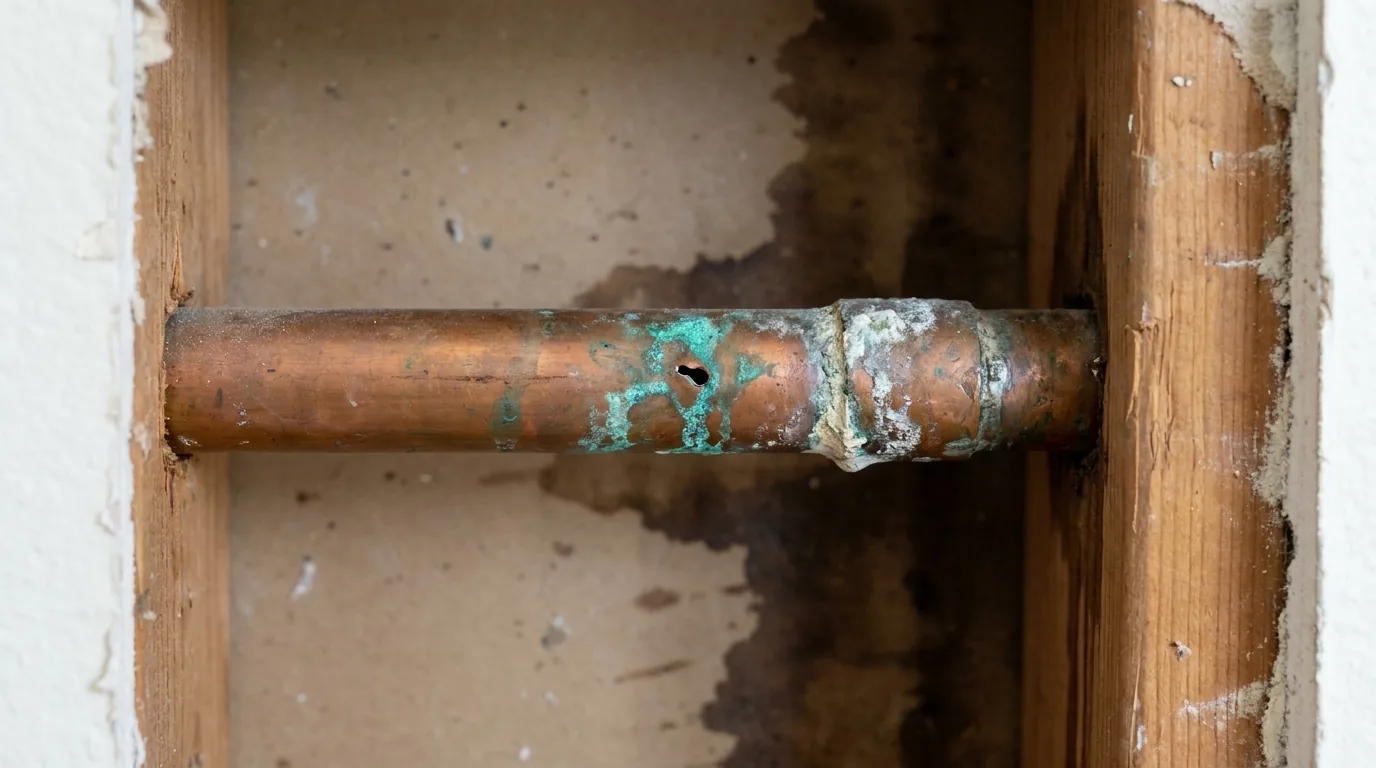
- Chloride is corrosive to metal. Fasteners, framing connectors, electrical boxes, wiring terminations, appliance components, ductwork, and reinforcing steel in concrete all corrode faster in the presence of residual salt. This damage continues for years after the water is gone, which is why the loss can resurface long after the claim is closed.
There is also a third effect that homeowners notice before anyone explains it: salt migrating to the surface as material dries leaves a white crystalline bloom on masonry and concrete, and salt trapped under paint pushes the finish off the wall. Repainting over it does not hold.
The correct sequence is flush, then dry, then verify
On a saltwater loss, drying is not the first step. Salvageable materials have to be flushed with clean water to carry the chloride out before drying begins. Dry it first and you have locked the salt into the material permanently.
- Extract standing water and remove the Category 3 porous materials — carpet and pad, affected drywall and insulation, particleboard.
- Clean and flush the remaining salvageable structure with clean water, not just a surface wipe.
- Dry with equipment to a documented drying goal, with daily moisture readings.
- Re-check after several days. This step is specific to saltwater and it is the one most often skipped. If readings climb back up in stable conditions, chloride remains in the material and it needs to be addressed rather than closed out.
- Inspect metal components in contact with the water — electrical boxes, connectors, HVAC, appliances — and document their condition before reconstruction covers them.
- Only then rebuild.
A crew quoting a conventional dry-out on a surge loss is quoting the wrong job. Not dishonestly, usually — simply because inland water losses do not behave this way and most restoration work in Southern California is inland.
The insurance reality, stated plainly
Standard California homeowners policies generally exclude flood, including storm surge and tidal overflow, and FAIR Plan dwelling fire policies exclude it as well. What responds to flood is separate NFIP or private flood coverage, which many coastal households do not carry.
There are usually a few remaining angles worth asking your broker about — wind-driven rain, sewer and drain backup endorsements, and coverage for consequential damage from a covered peril. We are not your adjuster and this is not coverage advice; your policy language and circumstances control. Our post on the California FAIR Plan covers how the two-policy structure works.
Because so much of this loss type is uninsured, the most valuable thing you can do in the first day is free: document everything before anything is removed. Photographs and video of the water line on every wall, of affected contents, and of the condition of everything you are about to discard. That record is what supports any claim, any assistance application, and any later dispute. It is the core of property damage management.
First 24 hours in a flooded coastal home
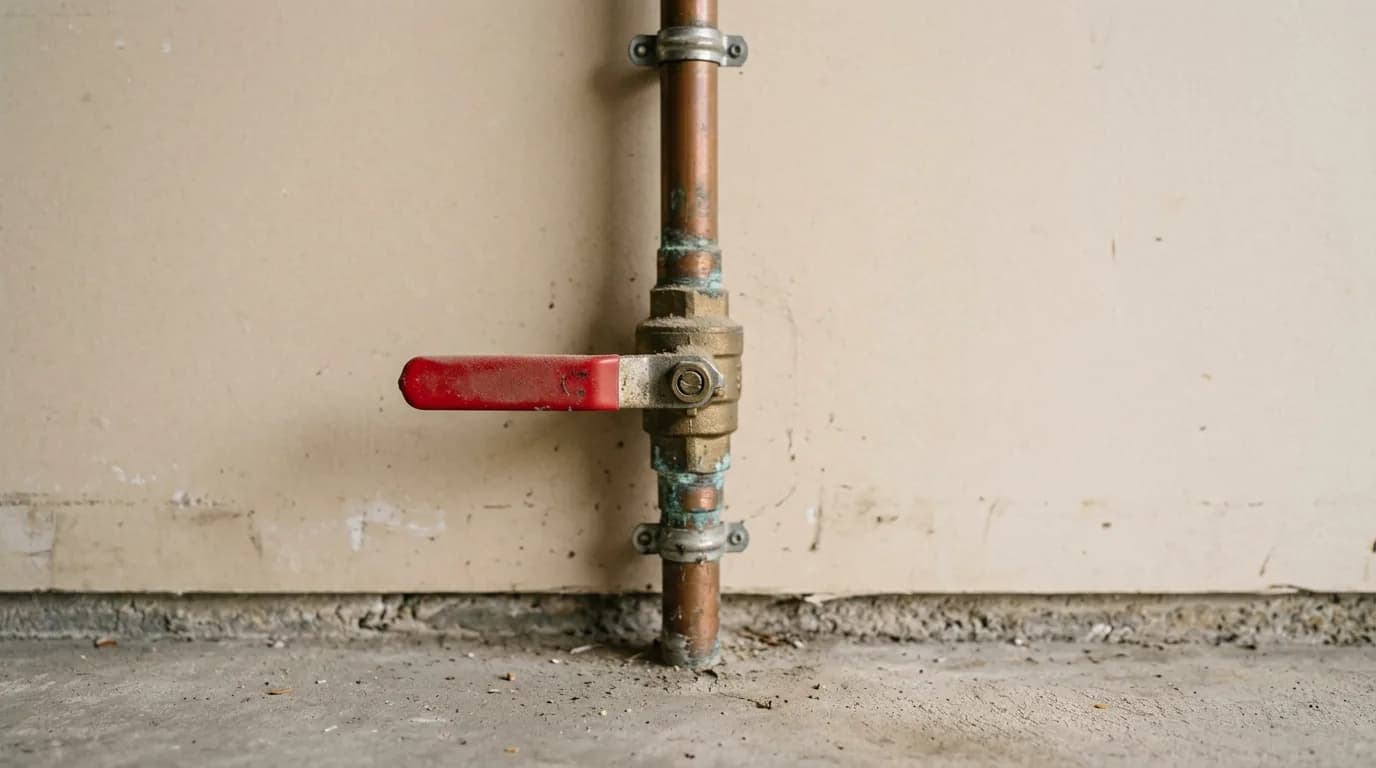
- Do not enter standing water if it has reached outlets, the panel, or any energized equipment. Kill power at the main from a dry location, or have the utility do it.
- Treat the water as contaminated. Boots, gloves, and no bare skin contact. Keep children and pets out.
- Photograph before you move anything, including the water line height on each wall.
- Get the water out and get air moving, but do not run the HVAC system — it will distribute contamination through the ductwork.
- Remove saturated porous contents from the structure rather than piling them inside it.
- Do not close any wall back up, and do not let anyone paint, until cavity moisture has been verified by meter.
Frequently asked questions
- Can drywall that was soaked in saltwater be dried and saved?
- Generally no. Saturated drywall in a Category 3 loss is a removal item both for contamination and because residual chloride will keep the material hygroscopic. Drywall wetted only at the very bottom edge is sometimes cut back rather than fully replaced, with flood cuts above the water line.
- Why does my wall still read wet after the dry-out?
- On a saltwater loss, that is usually residual chloride pulling moisture back out of humid air rather than an active leak. It is a sign the material was dried before the salt was flushed out. The remedy is addressing the salt, not more equipment.
- Does homeowners insurance cover storm surge flooding?
- Standard homeowners policies generally exclude flood, including storm surge and tidal overflow. Separate NFIP or private flood coverage is what responds. Ask your broker about wind-driven rain and sewer backup endorsements, which sometimes apply to part of a loss. Your policy language controls.
- How long before mold becomes a problem after flooding?
- Growth can begin within 24 to 48 hours on wet organic materials at ordinary temperatures. In a coastal home, high ambient humidity means conditions stay favorable well after the standing water is gone, so speed matters more here than inland.
- Is the concrete slab affected?
- It can be. Concrete is porous and absorbs chloride, which then attacks reinforcing steel over time and can interfere with adhesion of new flooring. Slabs are usually salvageable, but they need flushing and drying rather than being assumed fine because they look fine.
Coastal response
Gallagher Restoration Co. dispatches from Canyon Lake with satellite offices in Huntington Beach and Carlsbad, which is what makes a 60-minute on-site target realistic on the Orange County and North County San Diego coast rather than aspirational. Family-owned for more than 15 years, IICRC-trained, CSLB #1061640. For flood response in Newport Beach and the surrounding coast, see our Newport Beach flood damage page, call (951) 541-0034 for 24/7 dispatch, or request an assessment.