A clogged condensate line is the most common summer water loss in Southern California. It starts as a small stain on the ceiling and ends as an attic mold job. Here is how to catch it early.
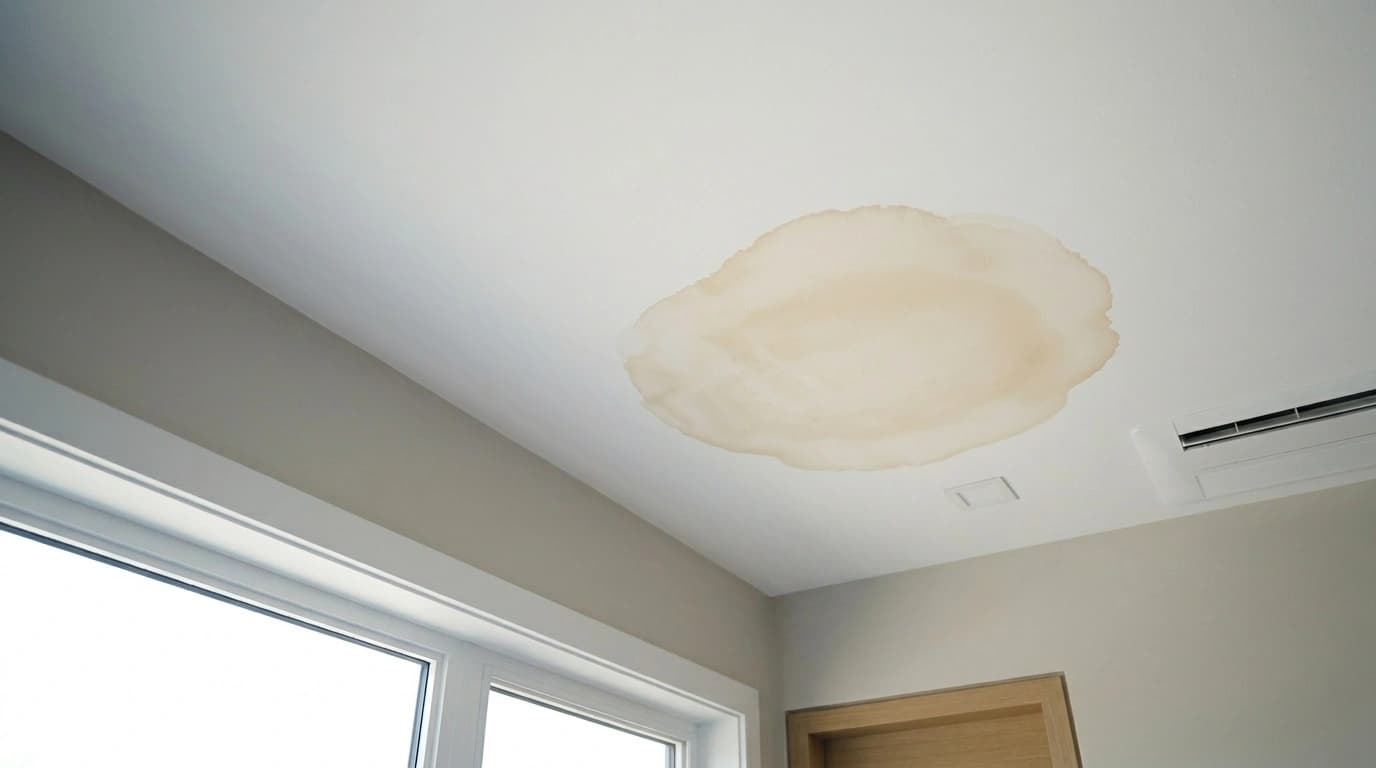
Every July and August, the same call comes in across the Inland Empire and Orange County: a brown ring on a hallway ceiling that was not there last week, directly below the attic air handler. Nine times out of ten it is not a roof leak. It is the air conditioner, and it has probably been leaking for days.
An air conditioner running on a 105-degree Menifee afternoon can pull several gallons of water out of the indoor air per day. All of that condensate is supposed to leave the house through a small drain line. When that line clogs, the water has to go somewhere — and in a house with an attic-mounted air handler, somewhere is your ceiling.
How a cooling system becomes a water loss
Warm indoor air passes over a cold evaporator coil, moisture condenses out of it, and the water drips into a drain pan and out through a PVC condensate line. Over time that line collects biological slime — algae and bacteria thrive in a dark, wet, room-temperature pipe. Once the line clogs, the primary pan overflows into a secondary pan; when that pan is rusted through, missing, or its own drain is blocked, the water goes straight into the ceiling insulation below.
ENERGY STAR's home HVAC maintenance checklist puts it plainly: a plugged drain can cause water damage in the house and affect indoor humidity levels. It is one of the few homeowner maintenance items that is genuinely cheap to do and genuinely expensive to skip.
The six causes we see most
- Clogged condensate drain line — by far the most common, and the easiest to prevent.
- Rusted or cracked drain pan on an air handler more than 12 to 15 years old.
- Disconnected or improperly sloped drain line, often disturbed during a previous attic repair.
- Frozen evaporator coil from a dirty filter or low refrigerant; when it thaws, it dumps far more water than the pan can hold.
- Missing or failed float switch — the safety device that shuts the system off when the pan fills.
- Undersized or sagging line sets that trap water and back it up over time.
Warning signs before the ceiling stains
By the time you see a stain, water has already been in the drywall and the insulation for a while. These are the earlier signals:
- A musty smell that gets stronger when the system runs.
- The AC short-cycling or shutting off on its own — often the float switch doing its job.
- Higher indoor humidity, or a house that feels clammy despite the thermostat being satisfied.
- Water in the secondary drain pan, or dripping from the secondary drain outlet on an exterior wall or eave.
- A faint bulge or soft spot in the ceiling texture that shows up before discoloration does.
What it costs — at each stage
| Stage Caught | Typical Scope | Estimated Cost Range |
|---|---|---|
| Preventive — annual drain flush | HVAC service call, line cleared | $100 – $250 |
| Early — active drip, no ceiling damage | Line clearing, pan replacement, float switch | $250 – $900 |
| Ceiling stained, drywall wet | Drying, drywall cut and patch, texture and paint | $1,200 – $3,500 |
| Insulation saturated, mold present | Insulation removal, containment, remediation, rebuild | $3,000 – $9,000+ |
| Long-term leak into wall cavity or framing | Structural drying, framing evaluation, extensive rebuild | $8,000 – $20,000+ |
The jump between rows three and four is the whole story. Water sitting in blown-in attic insulation does not evaporate quickly, and insulation holds it against the drywall like a sponge. That is the condition that converts a $600 repair into a mold job — and mold from a maintenance failure is exactly the category insurers most often decline. Our guide to water damage insurance coverage in California covers where that line falls.
What to do the moment you see it
- Turn the air conditioning off at the thermostat. Every additional run cycle adds more water.
- Put a container under any active drip and pull furniture and rugs out from underneath.
- Do not poke or drain a bulging ceiling yourself unless you are certain what is above it — a saturated section can release all at once and bring the drywall with it.
- Photograph the ceiling, the attic pan, and the stain before anything is touched.
- Call for ceiling water damage assessment. Moisture meters and thermal imaging will show how far the water actually traveled, which is almost always further than the visible stain.
Why attic units make this worse in Southern California
In much of the country the air handler lives in a basement or a conditioned closet, where a leak lands on a concrete floor. Across Riverside County, San Bernardino County, and much of Orange County, it lives in a vented attic — above the finished ceiling, in a space that reaches 130°F in summer and that almost nobody enters between March and October. A slow leak has months to work before it announces itself.
That same heat is why the resulting mold moves fast. A wet cellulose or fiberglass batt at attic temperatures is close to an ideal growth environment, and the growth happens above the ceiling where you cannot see it. If the smell arrived before the stain, read the signs of mold behind walls and ceilings.
Prevention that actually works
- Flush the condensate line at the start of cooling season — a wet/dry vac at the exterior outlet, or distilled vinegar poured into the access tee.
- Change filters on schedule. A restricted filter is the leading cause of coil freeze-ups.
- Confirm a working float switch exists on any attic-mounted unit. It is an inexpensive part that prevents most ceiling losses outright.
- Have the secondary pan inspected annually for rust-through — pans on older units frequently fail before the unit does.
- Look at the ceiling below the air handler once a month during summer. Thirty seconds, and it catches the problem while it is still a $600 problem.
Frequently asked questions
- How much water can an AC leak into a ceiling?
- A residential system in Southern California summer conditions commonly produces 5 to 20 gallons of condensate per day depending on capacity, runtime, and indoor humidity. If the line is fully clogged, most of that ends up in the drain pan and then in the ceiling assembly below, which is why a leak that goes unnoticed over a long weekend can saturate a large area.
- Is a ceiling leak from an AC covered by homeowners insurance?
- It depends on how the carrier characterizes the failure. A sudden component failure — a cracked pan or a coil that froze and dumped — is often treated as sudden and accidental. A drain line that clogged gradually over months is frequently classified as a maintenance issue and declined. Documentation from the HVAC technician and the restoration contractor is what usually decides it.
- Can I just paint over the water stain?
- Painting over a stain hides the symptom and leaves the moisture. If the insulation above is still wet, the stain will return, and mold growth continues out of sight. Confirm the assembly is dry with a moisture meter first, then repair, then paint.
- Do I need the whole ceiling replaced?
- Usually not. Most ceiling losses from condensate leaks are contained to a section that can be cut out, dried, replaced, and re-textured. Full replacement is generally reserved for cases where water traveled along joists across a large area or where the texture cannot be matched.
Caught it early? Call before the drywall does
Gallagher Restoration Co. handles ceiling and attic water losses across four Southern California counties from our Canyon Lake headquarters — IICRC-trained, family-owned for more than 15 years, CSLB #1061640. We dispatch 24/7 and aim to be on-site within 60 minutes. Call (951) 541-0034 or request an assessment, and we will tell you honestly whether this needs a crew or just an HVAC service call.