Every Southern California heating system sits idle for most of the year and then gets switched on during the first cold evening. Which smells are normal, which are not, and the two failures that put soot and water into a house.
A Southern California heating system does almost nothing for eight or nine months and then gets switched on, usually at night, usually because it finally got cold enough that someone gave in. That is a strange duty cycle for a combustion appliance, and it is why the first run of the season is when problems announce themselves.
Most of what people notice on that first run is harmless. Some of it is not, and the difference is worth knowing before you spend an evening wondering about it.
The normal one: dust burn-off
A hot, slightly acrid smell on the first run is almost always dust that settled on the heat exchanger and burner assembly over the idle months burning off. It is the same smell as a space heater on its first use.
What makes it normal is that it fades. Expect it for the first cycle or two, maybe thirty minutes total, then gone. Open a couple of windows and let it clear.
What makes it not normal is persistence. A burning smell that is still there on the third day, or that returns at full strength every time the system kicks on, is not dust — dust only burns off once.
The smells that mean stop
- Gas or rotten eggs. Leave the house, do not touch switches, and call the gas utility from outside. This is the one with no judgment call attached.
- Burning plastic or electrical. Shut the system off at the thermostat and the breaker. This is wiring, a failing blower motor, or something melting, and it is a fire risk.
- Smoke, or a sooty smell with visible black dust on registers. Combustion products are entering the living space rather than going up the flue.
- A persistent musty or sour smell. Not a combustion issue — usually moisture somewhere in the system or the ductwork, which is its own problem.
- Any burning smell that does not fade after the first couple of cycles.
Two failures that create restoration work
Most heating problems are an HVAC call, not ours. Two of them are not, because of what they put into the house.
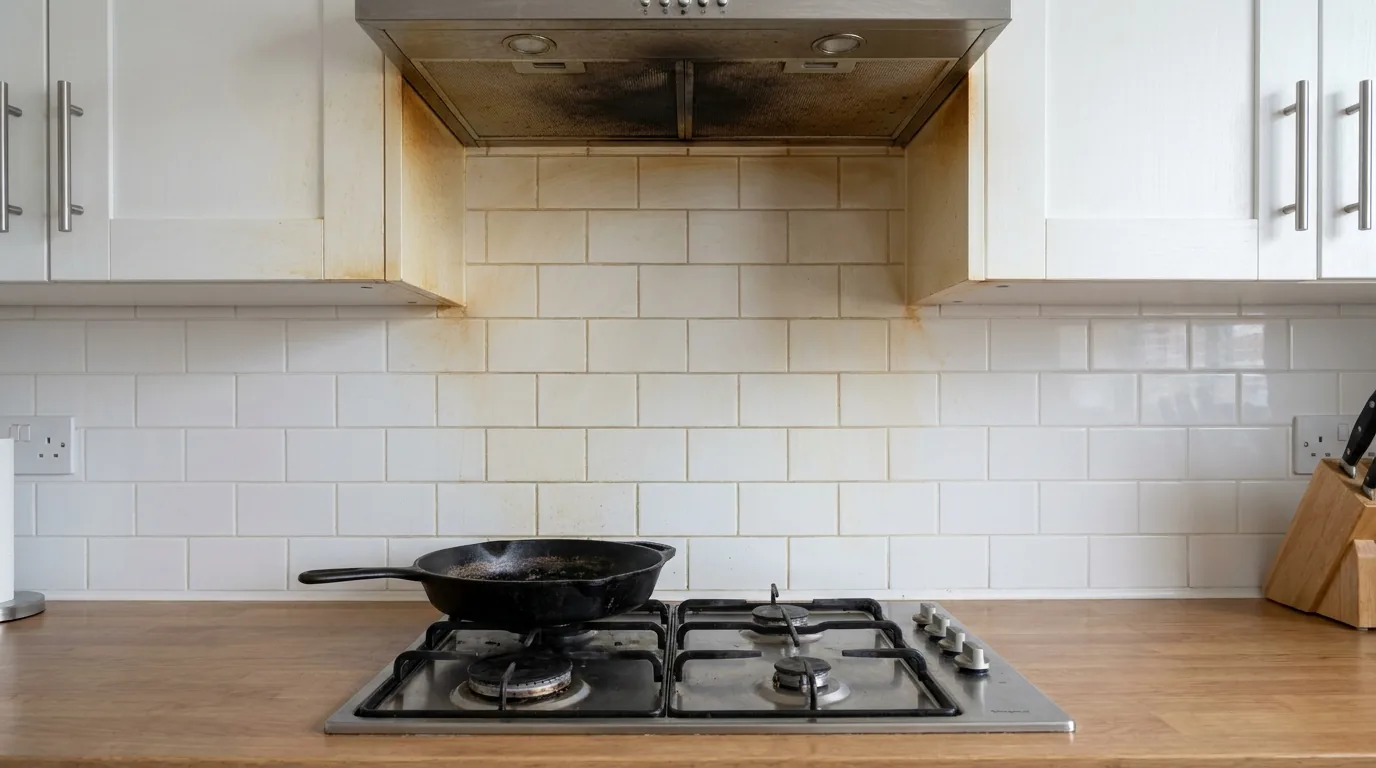
The first is a combustion problem that deposits soot. When a gas burner is not combusting cleanly — a dirty or misaligned burner, restricted airflow, a cracked heat exchanger, a blocked or compromised flue — the result can be soot carried into the air handler and distributed through the ductwork into every room. Homeowners usually notice it as fine black dust around the supply registers, or a grey film appearing on walls and above doorways, or an unexplained smoky smell in rooms nowhere near the furnace.
Furnace soot is an oily, fine-particle residue, and it behaves like the fuel-oil residue described in our grease fire post: wiping it smears it, and painting over it seals the odor in. Because the delivery mechanism is the duct system, it is genuinely whole-house rather than localized, and the ductwork itself has to be part of the remediation or the system redistributes it the moment heat is called for again. That is smoke clean-up work, not a cleaning-day problem.
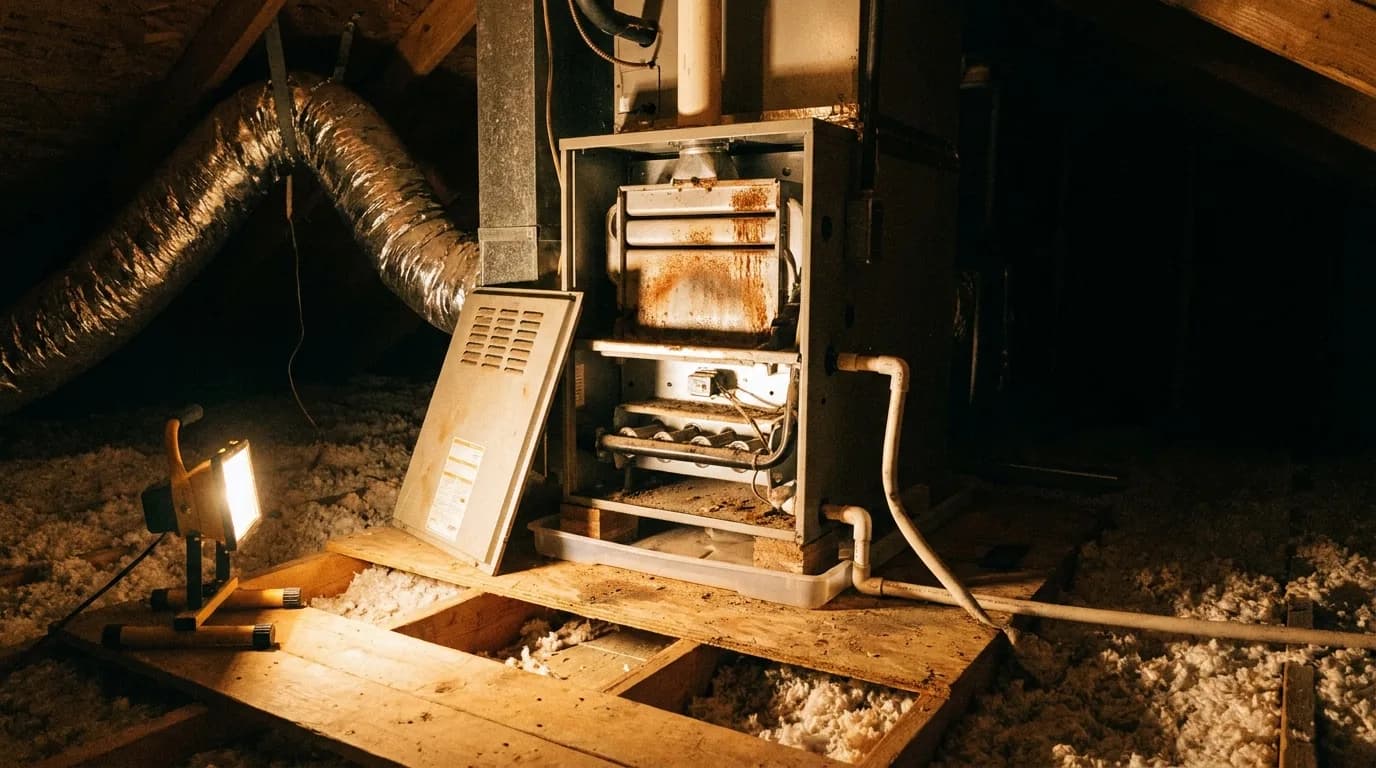
The second is water, and it catches people because they associate the heater with the dry season. In most Southern California homes the furnace and the air conditioning share an air handler, frequently on an attic platform. That unit has a condensate drain pan and line from the cooling side. Over a long summer the line can clog with algae and debris, and the secondary pan and float switch — if they were even installed and are working — are what stand between that and the ceiling below.
You find out at the first heavy run of either season. An attic air handler leaking into the ceiling is one of the more expensive residential losses there is, because by the time staining appears below, insulation and framing have been wet for a while. The pattern from underneath is in air conditioner leaking water damage to a ceiling and in ceiling water damage.
Carbon monoxide is the one that does not announce itself
Everything above has a smell or a visible symptom. Carbon monoxide has neither. It is colorless and odorless, and the early symptoms — headache, dizziness, nausea, fatigue — are easy to attribute to something else, particularly at night.
Any fuel-burning appliance can produce it when combustion is incomplete or venting is compromised: the furnace, a water heater, a gas range, a fireplace with a blocked flue. California law requires carbon monoxide alarms in dwellings with fuel-burning appliances, attached garages, or fireplaces.
- Test every CO alarm at the start of the heating season, and replace the batteries.
- Check the manufacture date on the unit itself. CO alarms have a service life, commonly in the five to ten year range, and an expired one can read fine while detecting nothing.
- Install them on every level and near sleeping areas.
- If an alarm sounds, get everyone outside first and call from there. Do not spend time investigating indoors.
What to do before the first cold evening
- Replace the air filter. It has likely been in there since the cooling season, and restricted airflow is a direct contributor to poor combustion and overheating.
- Have the system serviced if it has been more than a year. A technician checks the heat exchanger, the burners, the flue, and the gas pressure — the four things that cause the problems in this article.
- Check the condensate drain line and the secondary pan while someone is up there. Pour water through and confirm it exits where it should.
- Clear the area around the furnace and the air handler. Stored boxes, paint, and solvents near a combustion appliance are a fire risk and they restrict the air it needs.
- Look at the flue and the exterior termination for nesting, debris, or obvious damage.
- Run the system for twenty minutes on a mild day, with windows open, rather than discovering a problem at ten at night in the cold.
- Test smoke and carbon monoxide alarms the same day.
If you have a fireplace as well, the same logic applies to it and the stakes are higher. Our post on what eight months of disuse does to a fireplace covers that side.
Frequently asked questions
- How long should the burning smell last on the first heater run?
- Typically the first cycle or two, roughly thirty minutes total, then it should be gone. If it is still present on the second or third day, or returns at full strength every time the heat comes on, that is not dust burn-off and the system should be looked at.
- There is black dust around my vents. Is that soot?
- It might be, and it might be ordinary dust or candle and cooking residue tracking through the system. The distinguishing features of soot are that it is very fine, oily to the touch, smears rather than brushes off, and tends to appear in patterns around registers and above doorways where airflow concentrates. If it smears, stop wiping and have it assessed — wiping is what drives it into the paint.
- Does homeowners insurance cover furnace puff-back or soot damage?
- Often yes for the resulting damage to the home and contents, treated as a sudden and accidental event, while excluding the failed furnace component itself. Carriers do push back where the cause is traced to deferred maintenance, so keeping service records matters. As always, your policy language controls.
- Can I clean furnace soot myself?
- Not well, and the attempts usually make the professional job harder. Soot is fine and oily; household wiping smears it into porous surfaces and spreads it to places it had not reached. It also recontaminates every time the system runs, so cleaning before the duct system is addressed is wasted effort.
- My attic air handler is leaking. Is that an HVAC call or a restoration call?
- Both, in that order of urgency — HVAC has to stop the water, and restoration has to deal with what got into the ceiling. If you are seeing staining or sagging below, call both the same day. Wet insulation above a ceiling does not dry on its own, and the mold clock starts in a day or two.
If the first run went badly
Gallagher Restoration Co. handles soot and smoke remediation, duct contamination, and ceiling water damage across Riverside, San Bernardino, Orange, and San Diego counties. Family-owned for more than 15 years, IICRC-trained, CSLB #1061640, 24/7 dispatch with a 60-minute on-site target, written scopes and direct carrier billing. Call (951) 541-0034 or request an assessment. Our winter preparation guide covers the rest of the house.