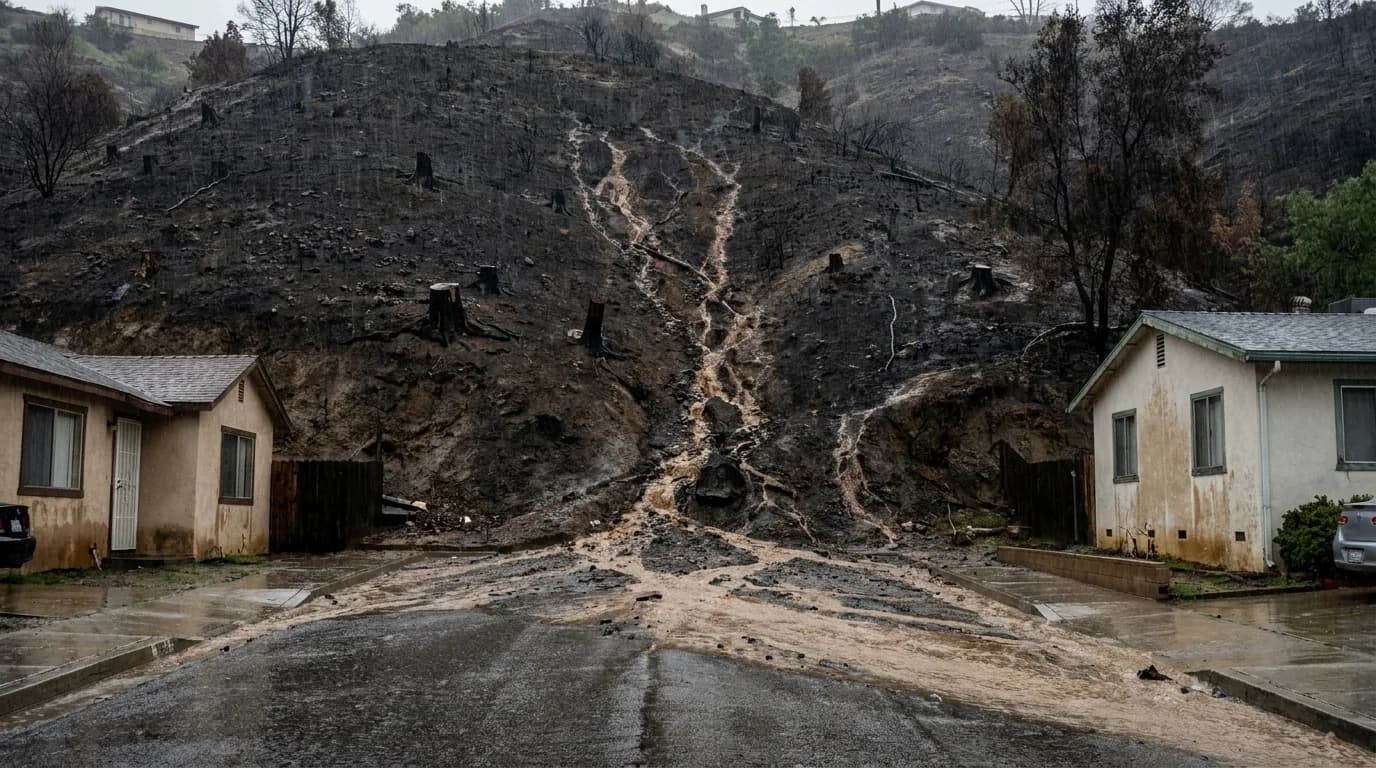
A hillside that burned in October behaves completely differently in January. Why burned ground sheds water instead of absorbing it, how little rain it takes, and the coverage gap almost nobody knows about.
Most of Southern California's annual rainfall arrives in a handful of storms. Atmospheric rivers — long, narrow corridors of concentrated water vapor moving in off the Pacific — can deliver in two days what the region otherwise gets in two months. In an ordinary year that is how the reservoirs fill and the hills turn green.
Below a hillside that burned in the last couple of years, it is something else entirely. The fire season and the rainy season are consecutive here, not separate, and the ground does not get time to recover in between. That sequence produces the losses we respond to every winter in homes that were never touched by flame.
What fire does to the ground itself
Two changes matter, and they compound.
The first is obvious: the vegetation is gone. Brush and grass normally intercept rainfall, slow it down, and hold soil in place with their root structure. Strip that away and rain hits bare ground at full velocity with nothing anchoring it.
The second is not obvious at all. Intense heat can vaporize organic compounds in the vegetation and soil, which then condense a short distance below the surface and form a water-repellent layer. The ground becomes hydrophobic — rain that would normally soak in beads up and runs off instead. A burned slope can shed a large fraction of the water that falls on it, where an unburned one would absorb most of it.
Combine them and runoff from a burn scar can be many times what the same hillside produced before the fire, arriving faster and carrying ash, soil, rock, and charred debris with it.
A debris flow is not a flood
This distinction matters practically and, as covered below, financially.
A flood is water that rises. A debris flow is a fast-moving slurry of water, mud, rock, and vegetation that behaves more like wet concrete in motion than like a river. It can move at speed, it carries boulders and burned timber, and it exerts force a flood does not. It fills a house rather than filling with water, and it arrives with very little warning.
The amount of rain required is the part that surprises people. It is not a season-defining storm. Post-fire debris flows are driven by short-duration rainfall intensity — how hard it rains in fifteen minutes — rather than by storm totals. A brief, intense cell over a burn scar can trigger one on a day the regional rainfall total looks unremarkable.
The risk window is years, not weeks
Elevated risk persists until vegetation re-establishes and the soil recovers, which generally takes a few years depending on burn severity, slope, and how the rainy seasons fall. The first wet season after a fire is the worst, and the risk declines from there rather than ending on a date.
If you are downslope of anything that burned in the last two or three seasons, the relevant question each winter is not whether the fire is old news. It is whether the hillside above you has grown back.
The coverage gap, stated plainly
This is the single most important thing in this article, and almost nobody learns it before they need it.
- Standard homeowners policies generally exclude flood, and they also generally exclude earth movement — landslide, mudslide, and earth sinking or shifting.
- Flood insurance through the NFIP covers flood, and it covers mudflow as that program specifically defines it, which is essentially a river of liquid and flowing mud. Landslide and general earth movement are not the same thing and are not covered.
- The practical result is that an event involving mud and debris coming off a hillside can land in a genuine grey area between two policies, or outside both.
There is one angle worth raising with your broker: when a fire is the proximate cause of subsequent damage, some claims have been argued on that basis. That is a policy-language and jurisdiction question, not a general rule, and it is exactly the kind of thing to ask about before a storm rather than after. We are not your adjuster and this is not coverage advice — your policy language and circumstances control. Our post on the California FAIR Plan covers how the two-policy structure works for households already pushed out of the standard market.
Note also that NFIP policies typically carry a waiting period before coverage takes effect. Buying it as the storm appears in the forecast is generally too late.
What to do before the season
- Find out whether you are below a burn scar. County and state hazard mapping is public, and local fire and emergency management agencies publish post-fire risk information for recently burned watersheds.
- Clear every drainage path on the property — swales, culverts, area drains, downspout discharges. A drain packed with ash and debris from the fire is the first thing to fail.
- Clean gutters and confirm downspouts discharge well away from the foundation rather than at a slab corner.
- Look at where water will go, not just where it falls. Walk the lot during a storm if you can. The path water takes across your property is the path mud will take.
- Talk to your broker about flood coverage, and ask specifically how mudflow and earth movement are treated on your policies. Mind the waiting period.
- Sign up for county emergency alerts, and know your evacuation route. Debris flow warnings can come with very little lead time.
- Photograph the property — every room, the exterior, the drainage. Ten minutes now is the evidence base for any claim later.
Sandbags and barriers have a role for diverting sheet flow and shallow mud, and they should not be mistaken for protection against a genuine debris flow. Against that, the plan is leaving, not defending the house.
What restoration looks like afterward
Debris flow and floodwater intrusion are Category 3 losses under industry standard — grossly contaminated, the same tier as sewage. The material entering the house carries soil bacteria, ash, burned structural debris, petroleum residue from roadways, and whatever the drainage system contributed. The framework is in water damage categories explained.
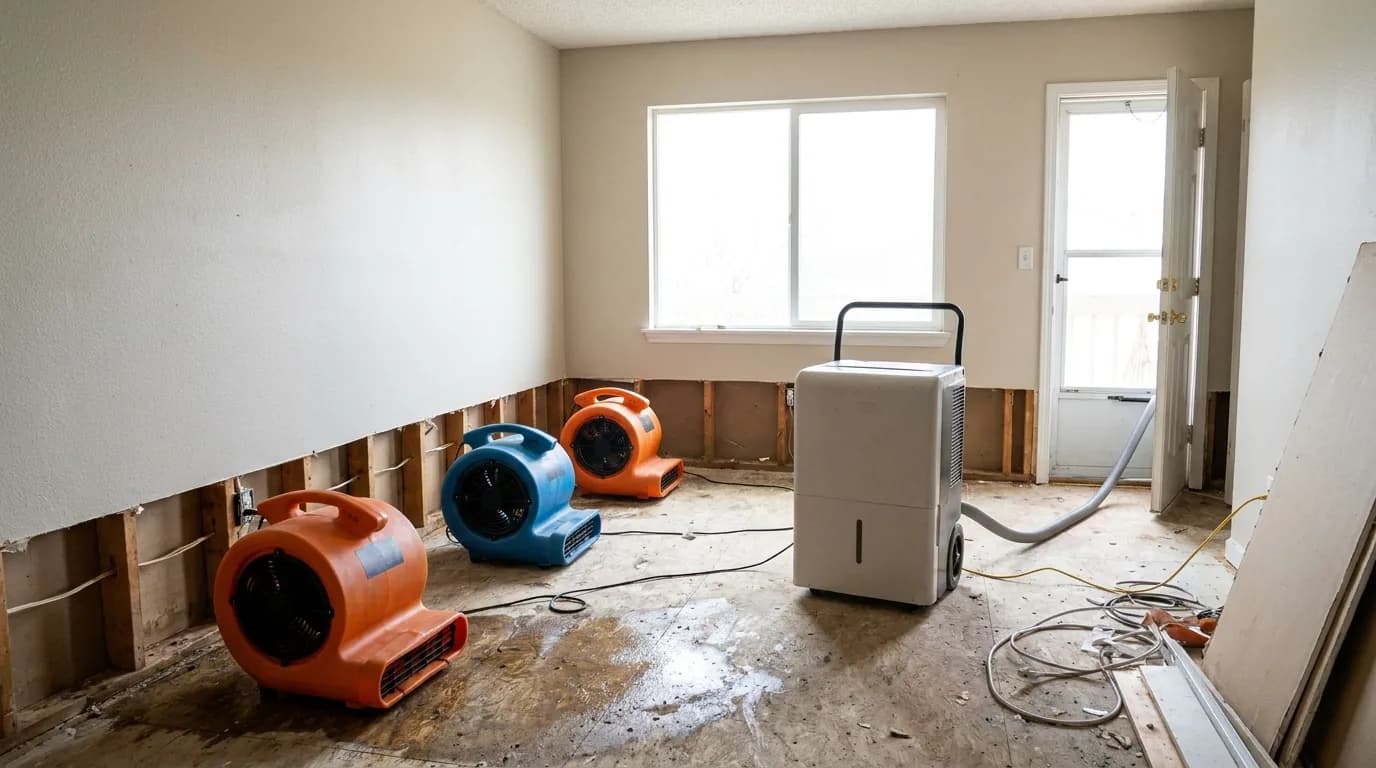
That classification drives the scope. Porous materials come out rather than being dried in place: carpet and pad, saturated drywall and the insulation behind it, particleboard cabinet bases, and affected contents. There is also a bulk-removal phase that an ordinary water loss does not have — mud and debris have to come out of the structure before any drying can begin, and the longer that sits the harder it gets, literally.
The first 24 hours matter in the same way they do for any contaminated-water loss. Do not enter if water has reached outlets or the panel. Treat everything as contaminated. Photograph before you move anything, including the mud line on each wall. Do not run the HVAC system. The sequence is the same one in our post on saltwater flooding, which is also a Category 3 event with a complication layered on top.
Frequently asked questions
- How much rain does it take to trigger a post-fire debris flow?
- Less than most people expect, because what matters is intensity rather than total. Short bursts of heavy rain over a burn scar are the trigger, which is why a debris flow can happen during a storm whose overall rainfall total looks ordinary. Agencies monitoring recently burned watersheds issue guidance based on short-duration rainfall rates for this reason.
- How long does burn scar risk last?
- Generally a few years, with the first wet season after the fire being the most dangerous and the risk tapering as vegetation returns and soil recovers. Burn severity, slope steepness, and how the rainy seasons fall all affect the timeline, so it is worth checking local guidance for your specific watershed rather than assuming a number.
- Does homeowners insurance cover mudslide damage?
- Usually not. Standard homeowners policies generally exclude both flood and earth movement. NFIP flood policies cover mudflow as that program defines it but not landslide or general earth movement. Because post-fire events can involve elements of both, this is the question to put to your broker in writing before the season, not during a claim.
- Is the mud left in my house dangerous?
- Treat it as contaminated. Post-fire debris carries ash from burned structures and vehicles alongside soil and organic material, and floodwater adds whatever it crossed on the way in. Use an N95 or better, gloves, and boots, keep children and pets out, and do not dry-sweep ash — keep it damp while removing it.
- Can I just hose the mud out?
- For a thin layer on a hard exterior surface, largely yes. Inside the structure it is a different job: the mud has to be removed, the contaminated porous materials have to come out, and the assembly then has to be cleaned and dried to a documented standard. Hosing it through the house spreads contamination into materials that were not affected.
If the hill comes down
Gallagher Restoration Co. dispatches 24/7 from Canyon Lake, with satellite offices in Huntington Beach and Carlsbad, across Riverside, San Bernardino, Orange, and San Diego counties. Family-owned for more than 15 years, IICRC-trained, CSLB #1061640, with written scopes, daily documentation, and direct carrier billing. We handle both mitigation and the rebuild. Call (951) 541-0034 or request an assessment. Our wildfire page covers the fire side of the same season.