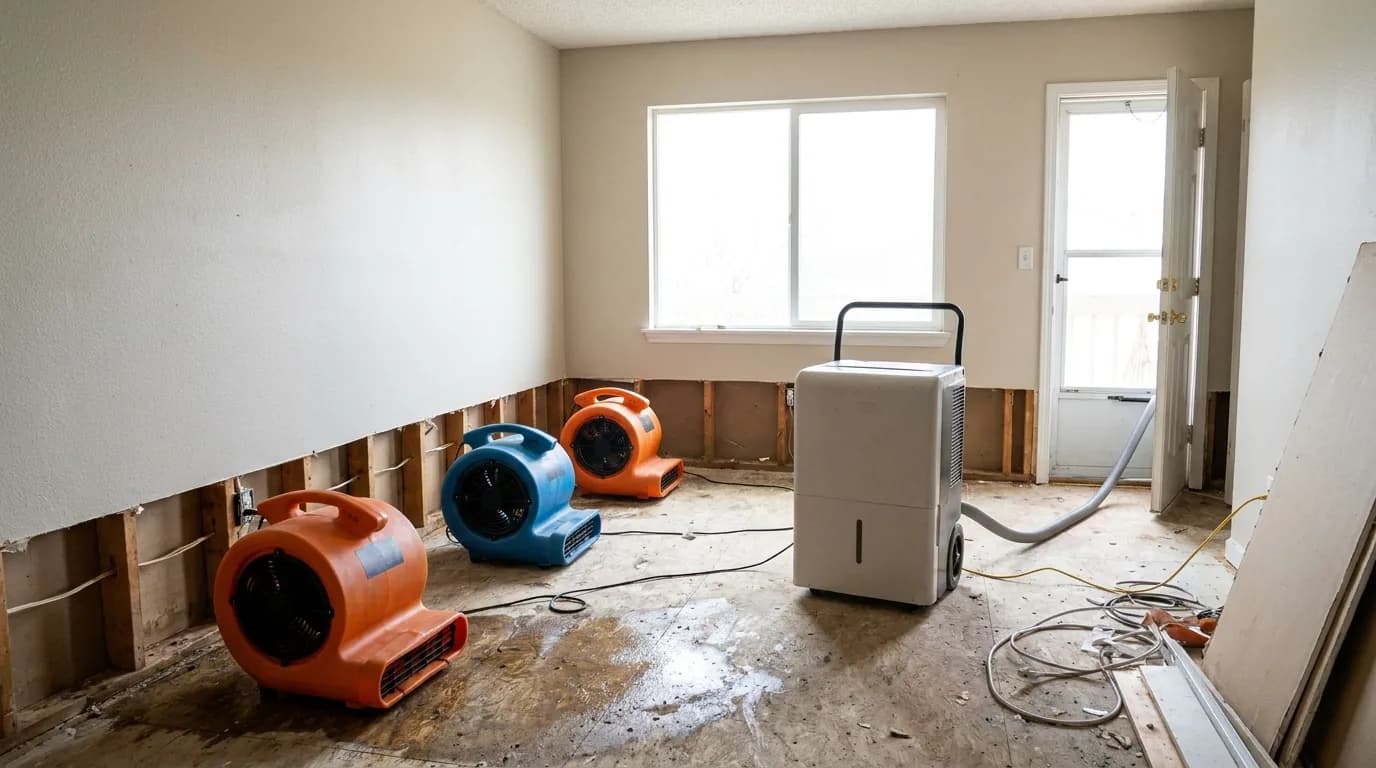
Two companies look at the same wet living room and quote numbers that are thousands apart. Here is what actually drives the price, what the line items mean, and how to compare bids that are not comparable.
The most common question we get on a first call is what this is going to cost, and the honest answer before anyone has seen the property is a range wide enough to be nearly useless. That is not evasion. It is that two water losses which look identical from the doorway can differ by a factor of ten depending on three things nobody can assess over the phone: how contaminated the water is, how far it travelled, and how long it sat.
What follows is how the pricing actually works, so you can read an estimate rather than just compare the number at the bottom.
The job is two jobs, and they are priced differently
Almost every confusion about restoration cost traces back to this. There are two distinct phases, often two separate estimates, and sometimes two different companies.
- Mitigation — the emergency phase. Extraction, removing unsalvageable materials, setting drying equipment, monitoring moisture daily until the structure hits a documented drying goal. This is time-sensitive, usually billed against industry-standard line items, and it is what insurers expect to happen without waiting for approval.
- Reconstruction — putting it back. Drywall, texture, paint, flooring, baseboard, cabinetry. This is ordinary contracting work, priced like a remodel, and it is typically the larger of the two numbers on anything beyond a small loss.
When someone says a water damage job cost eight thousand dollars, ask which phase they mean. A mitigation invoice and a total project cost are different animals, and quoting one against the other is the most common apples-to-oranges comparison homeowners make.
What actually drives the number
Six variables account for most of the spread between a small invoice and a large one.
| Driver | Why It Moves the Price |
|---|---|
| Water category | Clean supply water can often be dried in place. Category 2 and 3 losses require removal and disposal of porous materials, containment, and cleaning |
| Affected area and class | How much material is wet, and how absorbent it is, sets how much equipment is needed and for how long |
| Dwell time | The single biggest multiplier. Water that sat degrades in category and reaches more material |
| Materials involved | Carpet and pad is cheap to replace. Hardwood, tile on a mud bed, custom cabinetry, and plaster are not |
| Equipment days | Air movers and dehumidifiers bill per unit per day; a three-day dry and a nine-day dry are very different invoices |
| Access and containment | Two-story travel, attic or crawlspace work, asbestos or lead testing in older homes, and occupied-home containment all add real cost |
Dwell time deserves its own emphasis because it is the only one you control. A supply line caught in an hour is usually an extraction and a short dry. The same line running for a weekend is demolition, remediation, and a rebuild. The reasoning is laid out in how long water damage restoration takes and in water damage categories explained.
Rough ranges, with the usual caveat
These are typical Southern California ranges for the mitigation phase only, assuming the loss is found reasonably promptly. They are a sense of scale, not a quote — the variables above move them substantially in either direction, and an on-site assessment is the only way to get a real number.
| Scenario | Typical Mitigation Range |
|---|---|
| Small clean-water loss, one room, caught quickly | $1,200 – $3,500 |
| Supply line or water heater failure, multiple rooms | $3,000 – $8,000 |
| Second-floor loss affecting the level below | $6,000 – $15,000 |
| Category 3 — sewage, flood, or long-dwell loss | $8,000 – $25,000+ |
| Mold remediation added to a water loss | $2,000 – $10,000+ on top |
Reconstruction is separate and is priced as construction work. On a significant loss it commonly exceeds the mitigation figure. For the mold side specifically, our mold remediation cost guide breaks that down on its own.
Why two estimates for the same loss disagree
Usually it is not that one company is overcharging. It is that they are describing two different jobs.
- Different scope. One estimate dries the drywall in place; the other removes two feet of it to dry the cavity properly. Those are different jobs with the same description at the top of the page.
- Different category assessment. If one company classifies the water as Category 1 and the other as Category 2, the entire approach changes.
- Equipment days assumed versus measured. An estimate built on three days of drying is cheaper than one built on what moisture readings actually require. The second one is honest; the first one becomes a supplement later.
- Mitigation only versus mitigation plus rebuild. The most common reason one number looks dramatically lower.
- Containment, testing, and disposal. Asbestos testing on a pre-1980s home, containment on an occupied house, and proper disposal of Category 3 material are real costs that a thin estimate quietly omits.
- Carrier pricing versus retail. Many companies estimate against standardized insurance pricing software. A cash-pay retail quote is built differently and will not line up item for item.
The practical move is to compare scopes rather than totals. If one estimate is thousands lower, find the line items the other one has that it does not — that difference is the actual question.
What insurance typically pays, and what it does not
Most homeowners policies cover sudden and accidental discharge — a burst pipe, a failed supply hose, an appliance that let go — including the resulting damage to floors, walls, and contents. They generally exclude the failed component itself, damage from long-term seepage that was visible and ignored, flood, and in most cases mold beyond a sublimit.
Mitigation does not require prior approval. You are obligated to prevent further damage under essentially every property policy, and reasonable mitigation costs are generally recoverable. Waiting for an adjuster before starting extraction tends to increase the loss and does not improve the claim. Keep every receipt. The broader picture is in does homeowners insurance cover water damage in California.
Questions that separate a real estimate from a number
- Is this mitigation only, or does it include reconstruction?
- What category and class are you assessing this at, and on what basis?
- How many days of equipment is this built on, and what happens if readings require more?
- Will I get daily moisture logs and a written drying goal?
- What is included for containment, testing, and disposal?
- Are you billing my carrier directly, and what am I responsible for beyond the deductible?
- Do you handle the rebuild, or do I need a second contractor?
The daily moisture log question is the most revealing one. A company that documents readings against a stated goal is telling you the equipment comes out when the structure is dry rather than when the schedule says so — and that documentation is also what defends the invoice if the carrier questions the drying duration.
Frequently asked questions
- Will filing a claim raise my premium?
- It can, and that is a real consideration on a small loss near your deductible. It is worth weighing the likely claim value against your deductible and your carrier's posture before filing. On anything involving Category 2 or 3 water, hidden cavity moisture, or more than one room, the repair cost almost always dominates that calculation.
- Can I dry it myself with fans and save the money?
- For a small, clean-water spill on a hard surface caught immediately, yes. Beyond that the problem is verification — household fans dry surfaces while cavities, subfloor, and insulation stay wet, and without a moisture meter you are guessing. The expensive version of this is finding out six weeks later, when the fix is remediation rather than drying.
- Why is equipment billed per day?
- Because that is what the work is. Air movers and dehumidifiers have to run continuously until the materials reach a documented dry standard, and the number of units is set by the affected area and material type. A three-day dry on an open tile floor and a nine-day dry on a saturated subfloor are genuinely different amounts of work.
- Is the cheapest estimate ever the right one?
- Sometimes, if the scopes genuinely match. Read both line by line first. The common pattern is that the cheaper one dries in place where the other removes material, or omits containment and disposal, or covers mitigation only — in which case it is not cheaper, it is smaller.
- Do you charge for the assessment?
- We provide a free on-site assessment across our service area, including a written scope before any work begins. Call (951) 541-0034 and we will tell you what we find, including when the answer is that you do not need us.
Get a real number
Gallagher Restoration Co. provides written scopes, daily moisture documentation, and direct carrier billing, and handles both mitigation and reconstruction so there is one accountable party across the whole job. Family-owned for more than 15 years, IICRC-trained, CSLB #1061640, serving Riverside, San Bernardino, Orange, and San Diego counties from Canyon Lake with satellite offices in Huntington Beach and Carlsbad. 24/7 dispatch, 60-minute on-site target. Call (951) 541-0034 or request an assessment.
Pricing in this article is general and illustrative. Your actual cost depends on the specifics of the loss and can only be established by an on-site assessment.