A sewage backup is a biohazard, not a plumbing inconvenience. Here is what to do immediately, what has to be thrown away, what it costs, and why most California policies do not cover it by default.
Sewage coming up through a floor drain, a shower pan, or a toilet is the one water event where the instinct to grab a mop is actively dangerous. It is classified as Category 3 water — grossly contaminated — and it carries bacteria, viruses, and parasites capable of causing serious illness through contact, inhalation of aerosolized droplets, or hand-to-mouth transfer.
Here is the first hour, in order.
The first hour
- Stop using water. Every flush, sink, dishwasher cycle, and washing machine drain adds volume to a system that is already backing up.
- Get everyone out of the affected area, including pets. Close the door if you can.
- Shut off electricity to the affected area at the breaker if you can do so safely and from a dry location. Do not step into standing water to reach a panel.
- Do not run the HVAC system. It aerosolizes contamination into the rest of the house.
- Photograph everything from the doorway. Do not wade in for a better angle.
- Call a plumber for the cause and a restoration company for the contamination. These are two different problems and two different trades.
- Call your insurance carrier and ask specifically whether you carry a sewer backup endorsement.
Why a mop is the wrong tool
Cleaning sewage without containment moves contamination rather than removing it. Mop water carries pathogens onto adjacent flooring. Foot traffic tracks it through the house. Wringing and splashing aerosolizes droplets into the air you are breathing without a respirator.
The CDC's guidelines for cleaning safely after a disaster are specific on this point: wear rubber boots, rubber gloves, and goggles where sewage is involved, and remove and discard drywall and insulation that has been contaminated with sewage or floodwater. Discard, not clean — that distinction is the core of the whole job.
What gets thrown away and what gets saved
| Material | Outcome | Why |
|---|---|---|
| Carpet and carpet pad | Discarded | Porous; contamination penetrates and cannot be reliably removed |
| Drywall below the water line | Cut out, typically 12–24 inches above | Wicks contaminated water upward inside the cavity |
| Insulation | Discarded | Holds contaminated moisture indefinitely |
| Particleboard and MDF cabinetry | Usually discarded | Swells and absorbs; cannot be sanitized |
| Upholstered furniture and mattresses | Usually discarded | Porous throughout |
| Tile, sealed concrete, glass, metal, solid wood | Cleaned and sanitized | Non-porous or semi-porous; surface treatable |
| Clothing and linens | Case by case | Often salvageable through professional laundering, not home washing |
What professional Category 3 cleanup actually involves
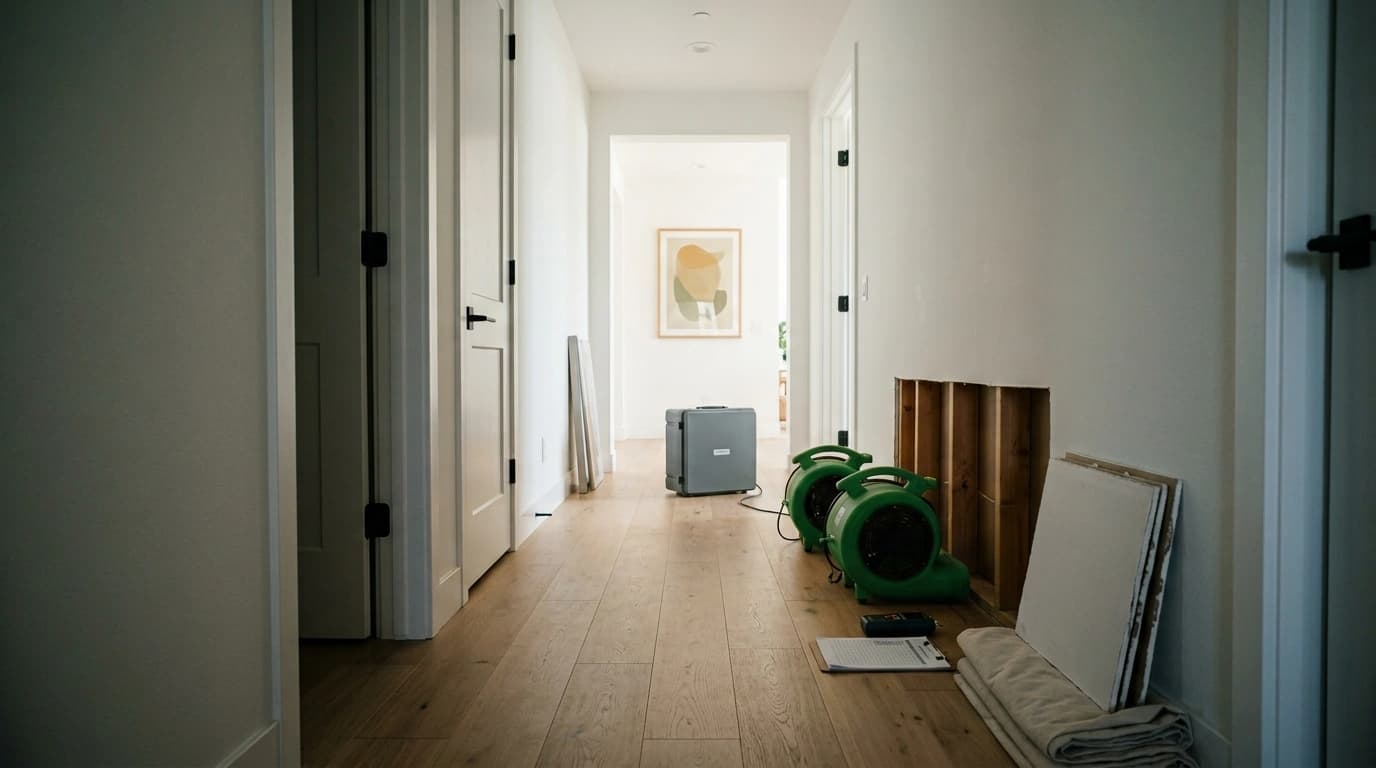
The scope is meaningfully different from a clean-water job. Technicians work in full PPE. The area is contained with plastic barriers and placed under negative air pressure with HEPA filtration so contaminated air does not migrate into the rest of the home. Contaminated materials are removed and disposed of as regulated waste. Remaining surfaces are cleaned, then treated with an EPA-registered antimicrobial. Then the structure is dried to a verified moisture standard, and only then is anything rebuilt.
Our sewage clean-up services follow that protocol on every job, regardless of size — a 20-square-foot backup in a laundry room gets the same containment discipline as a whole-floor event, because the biological risk does not scale down with the square footage. Our overview of water damage categories explains where Category 3 sits relative to clean and gray water.
What it costs
| Scope | Typical Situation | Estimated Cost Range |
|---|---|---|
| Small — single bathroom, hard flooring | Contained, caught immediately | $1,500 – $4,000 |
| Medium — multiple rooms, carpet involved | Flooring and lower drywall removed | $4,000 – $9,000 |
| Large — extensive area or long dwell time | Cabinetry and structural drying included | $9,000 – $20,000+ |
| Plumbing repair (separate) | Line clearing, camera inspection, or lateral repair | $300 – $12,000+ |
Costs run higher than an equivalent clean-water loss for three reasons: PPE and containment labor, regulated disposal, and the fact that porous materials are removed rather than dried.
The insurance problem nobody warns you about
Sewer and drain backup is excluded from most standard California homeowners policies. It is covered by a separate endorsement, typically inexpensive, that many homeowners have never been offered. If you do not have it, the cleanup is generally out of pocket — which is why the phone call to your carrier in that first hour is to ask about the endorsement specifically rather than to ask whether "water damage" is covered.
There is a second path worth knowing: if the backup originated in the municipal main rather than your private lateral, the city or sanitation district may bear responsibility. That claim requires documentation of the source, timing, and conditions — which means photographs and a plumber's camera inspection report, not recollection. Our guide to California water damage insurance coverage covers the broader coverage map.
Why these happen in Southern California
- Root intrusion into clay sewer laterals under mature landscaping — the single most common cause in older neighborhoods across Riverside and San Bernardino counties.
- Grease accumulation in the lateral, built up over years.
- Storm surcharge during heavy winter rain, when infiltration overwhelms the collection system.
- Collapsed or offset clay pipe in homes built before the 1970s.
- Wipes and non-flushable products — the leading cause of sudden blockages in newer homes.
- Slab settlement creating a belly in the line where solids accumulate.
Frequently asked questions
- Can I clean up a small sewage backup myself?
- For a very small spill on hard, non-porous flooring — a few square feet of tile — cleanup with heavy gloves, eye protection, a respirator, and a disinfectant is reasonable, followed by thorough hand washing. Once sewage reaches carpet, drywall, cabinetry, or subfloor, or if anyone in the household is pregnant, immune-compromised, elderly, or very young, it should be handled professionally.
- How long after a sewage backup is the area unsafe?
- The area stays a contamination risk until it has been physically cleaned, treated with an antimicrobial, and dried. Drying alone does not resolve it — pathogens remain viable on dried surfaces. Mold becomes an additional concern within 24 to 48 hours on top of the bacterial risk.
- Does homeowners insurance cover sewage backup?
- Not under most standard California policies. Coverage requires a sewer and water backup endorsement, which is usually an inexpensive add-on. Check your declarations page for it — and if you do not have one, it is worth adding at your next renewal regardless of whether you have ever had a backup.
- Do I have to replace my flooring after a sewage backup?
- Carpet and pad are replaced without exception. Hard flooring depends on the material and the seams: sealed tile with intact grout can often be cleaned and saved, while laminate, engineered wood, and vinyl plank with open seams typically come out because contaminated water reaches the substrate beneath them.
Do not wait on this one
Sewage backups get worse by the hour, and the health risk is real. Gallagher Restoration Co. runs full Category 3 protocol — containment, PPE, HEPA negative air, regulated disposal, antimicrobial treatment, and verified drying — across four Southern California counties from our Canyon Lake headquarters. Family-owned for more than 15 years, IICRC-trained, CSLB #1061640. Call (951) 541-0034 for 24/7 dispatch with a 60-minute response target, or request an assessment.