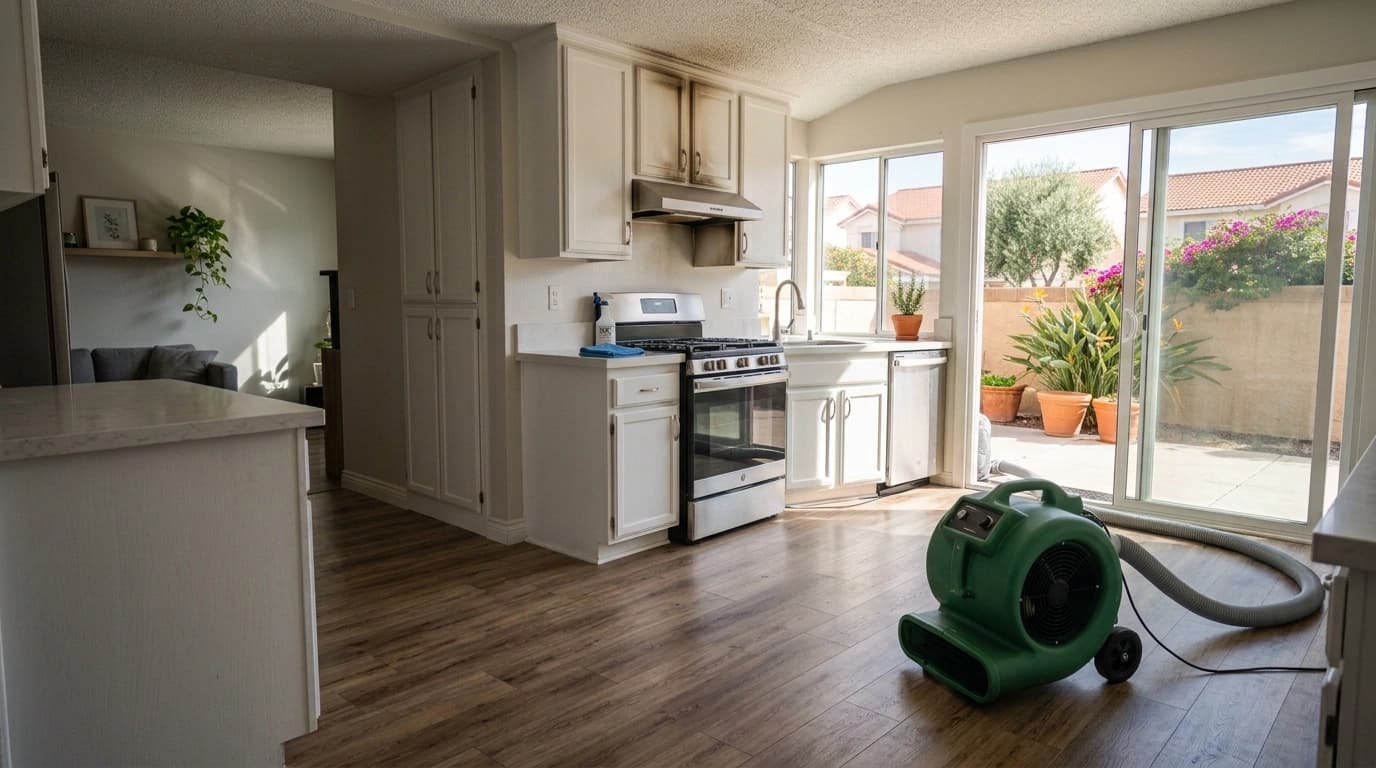
The fire department leaves and the house is quiet. What happens in the next three days shapes your insurance claim, what can be salvaged, and how long you are displaced. Here is the sequence that matters.
The hardest part of a house fire, for most people, is not the fire. It is the silence afterward — standing in a driveway at 3 a.m. with no idea what happens next. What follows is the sequence that actually matters, in order, based on what we see work and what we see cost people.
Hour 0–4: safety and shelter
Do not re-enter until the fire department clears the structure, no matter how contained the fire looked. Hidden hot spots, weakened framing, compromised electrical, and gas hazards are all real. The American Red Cross's guidance on recovering after a home fire is direct on this: stay out of a fire-damaged home until local authorities say it is safe to re-enter, and check the exterior for loose power lines, damaged gas lines, and structural damage before anyone goes in.
Call your local Red Cross chapter if you need immediate shelter, clothing, or essentials. They provide emergency assistance the same night, and it is not means-tested.
Hour 4–12: the two calls that matter most
Call your insurance carrier and open the claim. Give them the basics — when, where, what happened. Ask two specific questions: what your additional living expenses coverage provides, and whether they will authorize emergency mitigation immediately. Most policies cover a hotel and reasonable meals from night one, and most carriers will approve emergency board-up and tarping without waiting for an adjuster.
Then call a restoration company for board-up and stabilization. An open structure is exposed to weather, animals, and theft, and most policies require you to take reasonable steps to prevent further damage. Waiting for the adjuster before securing the property is a common and expensive mistake — the intervening damage may not be covered.
Hour 12–24: why smoke keeps working after the fire is out
This is the part almost nobody knows. Smoke residue is chemically active and continues to damage materials after the flames are gone. Combustion byproducts are acidic; combined with the water used to extinguish the fire and Southern California's daytime heat, they attack surfaces on a clock:
| Time Since Fire | What Happens Without Intervention |
|---|---|
| First hours | Residue settles into porous surfaces; odor penetrates fabric and drywall |
| 24–48 hours | Metal begins to corrode; grout, marble, and porcelain start to stain permanently |
| Days 2–7 | Wood, vinyl, and painted surfaces yellow; fiberglass and plastics discolor |
| Week 2+ | Etching and staining become permanent; salvageable items cross into replacement |
| Any point with standing water | Mold begins within 24–48 hours in wet materials |
That table is the entire argument for calling a restoration company quickly rather than waiting for the claim to be processed. The salvage window is measured in days, and every day of delay converts restorable contents into replacement line items. Our overview of fire damage restoration covers how that stabilization work sequences.
Day 1–3: documentation
- Photograph and video everything before anything is moved, including closets, drawers, and the garage.
- Start a contents inventory — room by room, with approximate purchase dates and values. It is tedious and it directly determines your personal property payout.
- Keep every receipt from the moment of the fire: hotel, meals, clothing, pet boarding, replacement toiletries. These are reimbursable under additional living expenses.
- Get the fire department's incident report number. Your carrier will ask for it.
- Log every conversation with the carrier — date, name, what was said. Claims outlast memories.
- Do not throw anything away, even items that look destroyed, until the adjuster has documented them.
What not to touch
- Do not wipe soot off walls or ceilings. Dry soot on a painted surface can often be cleaned by a professional; smeared soot pushes into the paint film and becomes permanent.
- Do not run the HVAC system. It distributes soot through ductwork into rooms the fire never reached.
- Do not turn on electronics that were exposed to smoke. Acidic residue on a circuit board plus power equals a short.
- Do not launder smoke-affected clothing in a home machine. Standard detergent sets the odor; textiles need specialized processing.
- Do not eat food from the refrigerator or pantry that was exposed to smoke or lost refrigeration, including sealed packaging that is not airtight.
Water damage comes with the fire
Firefighting can put thousands of gallons into a structure in minutes, and that water goes to the lowest point in the house. Nearly every fire we respond to is simultaneously a water loss, which means emergency water removal and structural drying begin alongside soot stabilization. If the water sits while the fire claim is being sorted out, you get a mold problem stacked on top of a fire problem — see our restoration timeline guide for how that clock runs.
Then odor, then rebuild
Once the structure is stabilized and dry, the work moves to soot removal and deodorization — smoke clean-up — followed by reconstruction of what was lost. Odor is its own discipline and is frequently the last thing resolved; our guide to getting smoke smell out of a house explains why the DIY approaches usually fail. Structural rebuild falls under reconstruction, and the timeline there depends heavily on permitting in your jurisdiction.
If the fire was a wildfire
Homes that did not burn can still sustain serious smoke and ash damage from a nearby wildfire, and that is a different scope with a different insurance conversation. Our wildfire damage pages and our guide to wildfire ash cleanup inside the home cover it. In our wildfire responses the most common finding is smoke and ash intrusion in homes several miles from any flame.
Frequently asked questions
- How soon can I go back into my house after a fire?
- Only after the fire department clears the structure, and even then usually only briefly and in protective footwear and clothing. Structural integrity, electrical hazards, and air quality all need to be evaluated. For anything beyond retrieving essential documents and medication, wait until a restoration contractor has assessed the property.
- Does insurance pay for a hotel after a house fire?
- Most homeowners policies include additional living expenses coverage that pays for reasonable temporary housing, meals above your normal grocery costs, and related expenses while the home is uninhabitable. Keep every receipt from the first night, and ask your adjuster to confirm your daily or aggregate limit early.
- Can smoke-damaged furniture and clothing be saved?
- Often, yes — if it is treated quickly. Textiles respond well to specialized cleaning processes that home laundering cannot replicate, and hard contents can frequently be cleaned and deodorized. The determining factor is almost always elapsed time, not the severity of the fire in that particular room.
- Who pays for the board-up?
- Emergency board-up and tarping are normally covered as part of your mitigation obligation under the policy, and most carriers authorize it without waiting for an adjuster visit. Document the condition of the property before and after the board-up, and keep the invoice for the claim file.
We can be there tonight
Gallagher Restoration Co. handles emergency board-up, water extraction, soot stabilization, and full fire rebuild across four Southern California counties from our Canyon Lake headquarters. Family-owned for more than 15 years, IICRC-trained, CSLB #1061640. Call (951) 541-0034 — we dispatch 24/7 with a 60-minute on-site target — or request an assessment. If you are still getting your bearings, our overview of fire damage basics covers the fundamentals.